Recipe · Isaan · The Soup That Isn't Tom Yum
Tom Saap (ต้มแซ่บ)
Pork ribs boiled with galangal, lemongrass and kaffir lime, soured hard, hit with roasted chilli and toasted rice. Isaan's answer to tom yum — no coconut milk, no mercy.
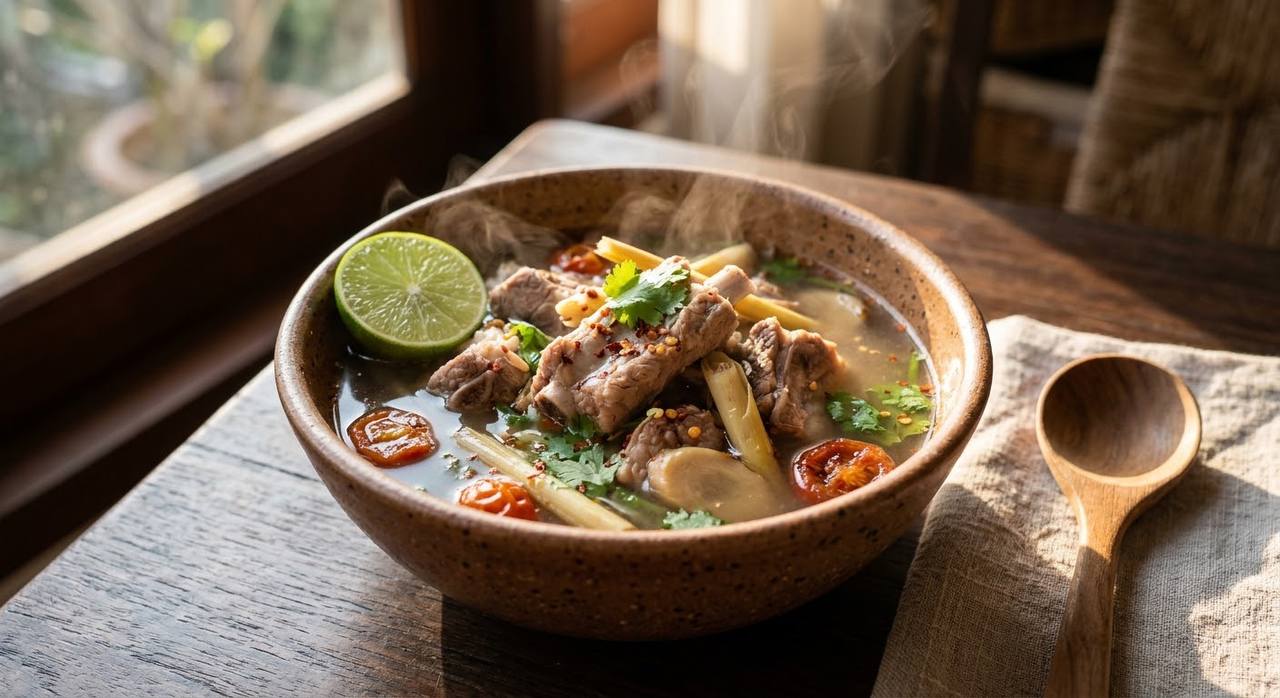
Pork ribs boiled with galangal, lemongrass and kaffir lime, soured hard, hit with roasted chilli and toasted rice. Isaan's answer to tom yum — no coconut milk, no mercy.
ต้มแซ่บ translates plainly: "boil" + "deliciously spicy". It is the Isaan bowl you order next to your som tam — a clear, sour, chilli-hot soup built on pork bones instead of prawns, lime or tamarind instead of cream, and toasted rice powder instead of anything soft. Where tom yum gets coconut milk and a polite heat, tom saap gets ข้าวคั่ว — toasted rice — and a chilli count the sources measure in multiples of ten.
It belongs to the same family as tom yum — the galangal, lemongrass and kaffir lime are all here — but it is the country version: no coconut, bones to gnaw on, and a finish of roasted chilli and lime that hits the back of the throat. One Kapook roundup of six tom saap recipes has been read 1.9 million times, and the street-stall version on TrueID promises "ซดน้ำเกลี้ยงหม้อ" — drink the pot dry.
The bones matter. Sources cook it with กระดูกอ่อนหมู — pork spare ribs with their soft cartilage — an hour in the pot, then the broth is seasoned at the end, never boiled with the lime. Lime goes in after the fire is off; boil lime juice and it turns bitter, and every published version knows it.
| Thai | English | Amount |
|---|---|---|
| กระดูกอ่อนหมู | Pork spare ribs, with soft cartilage | 200 g |
| น้ำเปล่า | Water | 500 ml |
| ข่าแก่ (หั่นแว่น) | Galangal, sliced | 5 slices |
| ตะไคร้ (หั่นเฉียง) | Lemongrass, sliced diagonally | 1 stalk |
| ใบมะกรูด (ฉีกก้านกลาง) | Kaffir lime leaves, torn | 3 |
| เห็ดฟาง (ผ่าครึ่ง) | Straw mushrooms, halved | 100 g |
| มะเขือเทศราชินี (ผ่าครึ่ง) | Cherry tomatoes, halved | 50 g |
| หอมแขก (ซอยบาง) | Shallot, thinly sliced | 1 |
| น้ำปลา | Fish sauce | 3 tbsp |
| น้ำมะขามเปียก | Tamarind water | 2 tbsp |
| น้ำตาลทราย | Sugar | 2 tsp |
| น้ำมะนาว | Fresh lime juice | 2 tbsp |
| พริกป่น | Roasted chilli powder | to taste |
| ข้าวคั่ว | Toasted rice powder | 1 tbsp |
Lime vs tamarind. The street-stall and Pantip versions sour with fresh lime only; พี่บัว's home version uses tamarind and no lime at all; the Kapook version uses both. All agree the souring happens at the end, never boiled.
When the herbs go in. พี่บัว simmers galangal, lemongrass and kaffir from the start with the bones. The Pantip recipe boils the bones for a full hour first, then adds the herbs at the end — so their aroma stays sharp instead of boiling away.
Tomatoes or not. Kapook and พี่บัว put tomatoes in the bowl; the street-stall and Pantip versions don't. The tomato is the home-cook's softening of a hard-country soup.
Toasted rice. ข้าวคั่ว in the Kapook and Pantip versions — the Isaan marker — but not in the street-stall's, which leans on its stock instead.
The shop trick. The TrueID street version adds น้ำกระเทียมดอง — pickled garlic brine — and stock cubes to the pot. Home versions use neither; it's the difference between a stall that sells ten pots a night and a bowl at home.
This recipe is translated from the following Thai-language sources. Where they disagree, we've said so.
1. Kapook — "6 สูตรต้มแซ่บ จัดเต็มความจัดจ้านจี๊ดจ๊าดพ่นไฟ" (six tom saap recipes; the pork-bone version used here, 1.9M reads) — cooking.kapook.com
2. Pantip — "ต้มแซ่บกระดูกหมูอ่อน จี๊ดจ๊าด แซ่บสะใจ สูตรทำง่ายๆ" (pork spare-rib version, herbs added after the boil, twenty chillies) — pantip.com
3. TrueID (พี่บัว) — "ต้มแซ่บกระดูก" (home version: tamarind sour, don't-stir trick, 20–30 minute boil) — food.trueid.net
4. TrueID (ครัวพิศพิไล) — "สูตรทำ ต้มเล้งแซ่บ เผ็ดจี๊ดถึงใจ ซดน้ำเกลี้ยงหม้อ" (the street-stall version: pickled-garlic brine, stock cubes, 142K reads) — food.trueid.net