Recipe · Thailand · The Curry That Means "Spicy"

Red Curry (แกงเผ็ด)

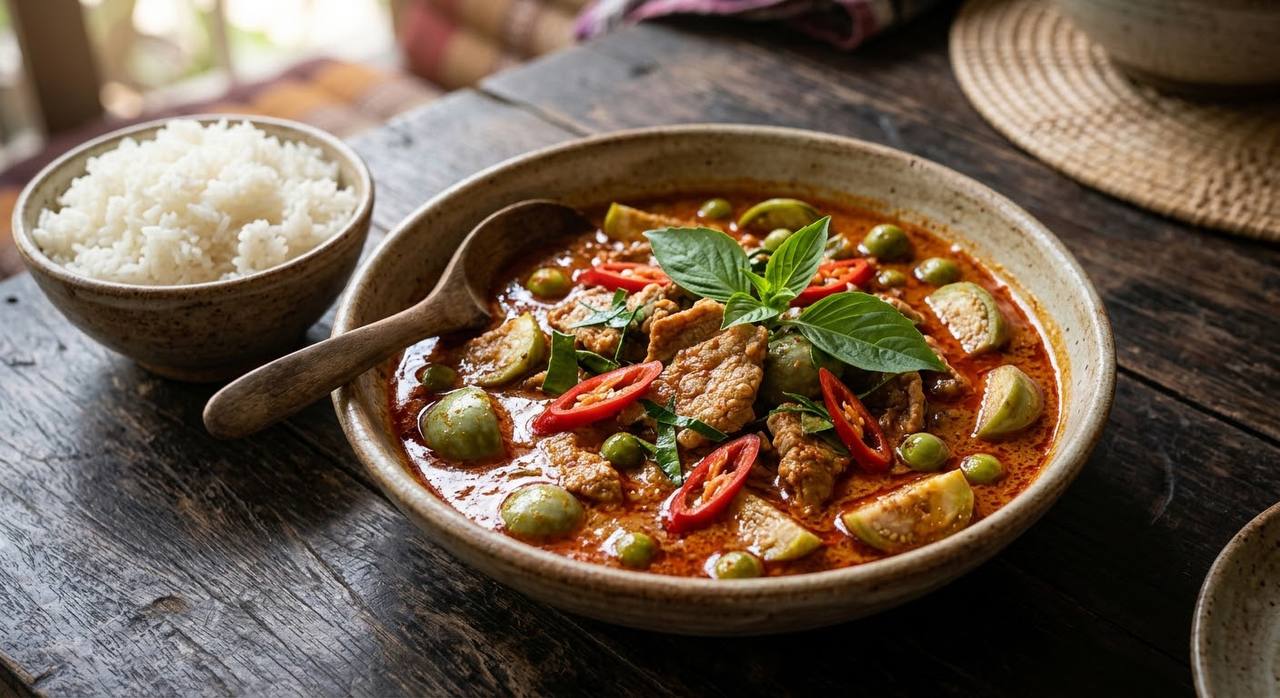
Dried chillies, not powder. Cracked coconut cream, not jar paste. Pork and aubergines, finished with basil and torn kaffir lime — the curry the UK knows as "red" and Thailand simply calls "spicy".

Red curry (แกงเผ็ด) with pork, apple and pea aubergines, Thai basil and kaffir lime leaves, jasmine rice on the side

The Curry Named for Being Spicy

แกงเผ็ด means "spicy curry" — and it earns the name. The redness isn't tomato or powder: it comes from a paste of soaked dried chillies pounded from scratch. In Thailand this is the everyday curry, the one home cooks make on a Tuesday with pork or chicken, and the one that turns into kaeng phet pet yang — roast-duck red curry — when the occasion matters.

The heart of the dish is the technique. Coconut cream is simmered in the pan until it cracks — the oil splits out and the surface turns glossy red — and only then does the paste go in. Skip that step and the curry never develops its depth, no matter how good the paste is.

And the dish has an older name. Thai food historians record the original as kaeng daeng — "red curry" — built on duck, pineapple and pineapple juice, with a paste enriched with mace, nutmeg and cumin. The modern version dropped the fruit and kept the heat. Both are documented below.

The Recipe (home-style pork version — serves 3–4)

ThaiEnglishAmount
The paste (makes extra — keeps about a week, refrigerated)
พริกจินดาแห้ง (แช่น้ำ)Dried jinda chillies, soaked soft100–120 g
ลูกผักชีCoriander seeds2 tbsp
พริกไทยขาวWhite peppercorns10
รากผักชี (สับ)Coriander roots, chopped2 tbsp
ตะไคร้ (ซอย)Lemongrass, sliced fine3 stalks
ข่า (ซอย)Galangal, sliced4–5 pieces
ผิวมะกรูด (สับ)Kaffir lime zest, chopped2 tsp
หอมแดงShallots80 g
กระเทียมGarlic60 g
กะปิShrimp paste1 tsp
เกลือSalt1 tsp
The curry
เนื้อหมูPork shoulder or loin, bite-size300 g
กะทิCoconut milk — 2 tins; reserve 200 ml of the thick cream to crack800 ml
มะเขือเปราะThai apple aubergines, quartered4
มะเขือพวงPea aubergines50 g
พริกชี้ฟ้าแดง (ซอย)Red spur chillies, sliced4–5
ใบมะกรูด (ฉีก)Kaffir lime leaves, torn5
ใบโหระพาThai basil1 handful
น้ำตาลปี๊บPalm sugar2 tsp
น้ำปลาFish sauce — or 1½ tsp salt, the sources split1½ tbsp
น้ำมันรำข้าวRice bran oil — only if using the oil-fry method1 tbsp

The Original: Kaeng Daeng, Duck and Pineapple (แกงแดง — recorded by อาจารย์ศรีสมร คงพันธุ์)

The older, richer character. To the same paste add 1 tsp mace (เปราะ), ¼ nutmeg (ลูกจันทน์) and 2 tsp cumin (ยี่หร่า), all dry-roasted before pounding. The curry itself takes 400 g roast duck, 100 g pineapple, 10 cherry tomatoes, 50 g pea aubergines and ½ cup pineapple juice — the fruit's sharp-sweet edge is what the modern version lost.

The recorded method cracks the head cream the same way: 1 cup head coconut cream cracked with 3 tbsp rice bran oil, the paste fried in it, the duck warmed through, then 3½ cups of thin coconut milk with the pineapple and juice simmered to order. Thai basil and kaffir lime leaves finish it, exactly as today.

If you can only try one restaurant version in Thailand, the roast-duck one is the one — it is the same dish in its Sunday clothes.

The Method

  1. Make the paste. Soak the dried chillies about 10 minutes until pliable. Pound the coriander seeds and white peppercorns to powder first, then the coriander roots, lemongrass, galangal, kaffir lime zest, shallots, garlic, shrimp paste, salt and the drained chillies — pound to a smooth paste. Keeps a week in the fridge.
  2. Crack the cream. Heat the thick head of coconut milk over medium heat and let it simmer until the oil visibly splits out — the surface turns glossy with red-orange oil. This is แตกมัน, and it is the depth of the dish.
  3. Fry the paste. Into the cracked cream, stirring, until it darkens and smells cooked. (The lighter route — a spoon of oil, the paste fried first, then the coconut milk — also appears in the sources; the crack is the classic.)
  4. Pork in. Stir-fry in the paste until sealed on the outside.
  5. Thin milk in. The rest of the coconut milk plus about 100 ml of water. Gentle boil, then simmer until the pork is tender — roughly 15 minutes.
  6. Aubergines. Apple aubergines first, pea aubergines a few minutes later. Cook just until tender; they should hold their shape.
  7. Season. Fish sauce (or salt) and palm sugar. Taste for the order: chilli heat leads, salt behind it, sweetness only rounding the edges.
  8. Finish. Off the heat, stir in the Thai basil, the sliced spur chillies and the torn kaffir lime leaves. Serve hot with jasmine rice.

Where Thai Sources Disagree

The paste's richness. The everyday market paste is chilli, coriander seed, lemongrass, galangal, shallot, garlic and shrimp paste. The recorded kaeng daeng paste adds mace, nutmeg and cumin. Neither is wrong — one is Tuesday, the other is festival day.

Crack vs fry. Maggi's Thai recipe cracks the cream first; the Wongnai home cook fries the paste in a spoon of oil first. Both work; the crack builds more depth.

Salt vs fish sauce. Home cooks genuinely split. Fish sauce adds savoury depth; salt keeps the chilli colour brighter. The recipe above gives both, honestly.

Sugar. From none in the strictest versions to three teaspoons in the sweetest. Palm sugar is the Thai choice — it rounds without a syrupy edge.

The pineapple question. The recorded kaeng daeng had pineapple and pineapple juice; modern kaeng phet has neither. Which one is "the real recipe" depends on which century you ask.

The protein. Pork and chicken are the everyday choices; roast duck is the classic; bamboo shoots and turkey berries swap in by region and by season.
How Western Versions Get It Wrong

UK Ingredient Notes

Sources

This recipe is translated from the following Thai-language sources. Where they disagree, we've said so.

1. Wongnai (Janeojane) — "สูตร แกงเผ็ดหมูใส่มะเขือ พร้อมวิธีทำ" (home pork version, full method and seasoning) — wongnai.com

2. Kapook — "น้ำพริกแกงเผ็ด สูตรโฮมเมด" (the paste from scratch, exact quantities and pounding order) — cooking.kapook.com

3. Phol Food Mafia — "Roast Duck Red Curry (แกงเผ็ดเป็ดย่าง)" สูตรโดย อาจารย์ศรีสมร คงพันธุ์, from พลพรรคนักปรุง 6 January 2010 (the recorded kaeng daeng with mace, nutmeg, cumin and pineapple) — pholfoodmafia.com

4. Maggi Thailand — "แกงเผ็ดหมู" (crack-the-cream method, step order) — maggi.co.th

Johnny Tiger
Johnny researches and translates Thai recipes from Thai-language sources — chefs, restaurants and home cooks in Thailand — and publishes them with their sources cited. No westernised shortcuts, no invented steps.