Recipe · Thailand · The Deep South Stir-Fry
Pad Sator (ผัดสะตอ)
Sataw — the stink bean — flash-fried with shrimp paste, bird's eye chillies, pork and prawns. The southern Thai plate that clears the room, then empties the rice pot.
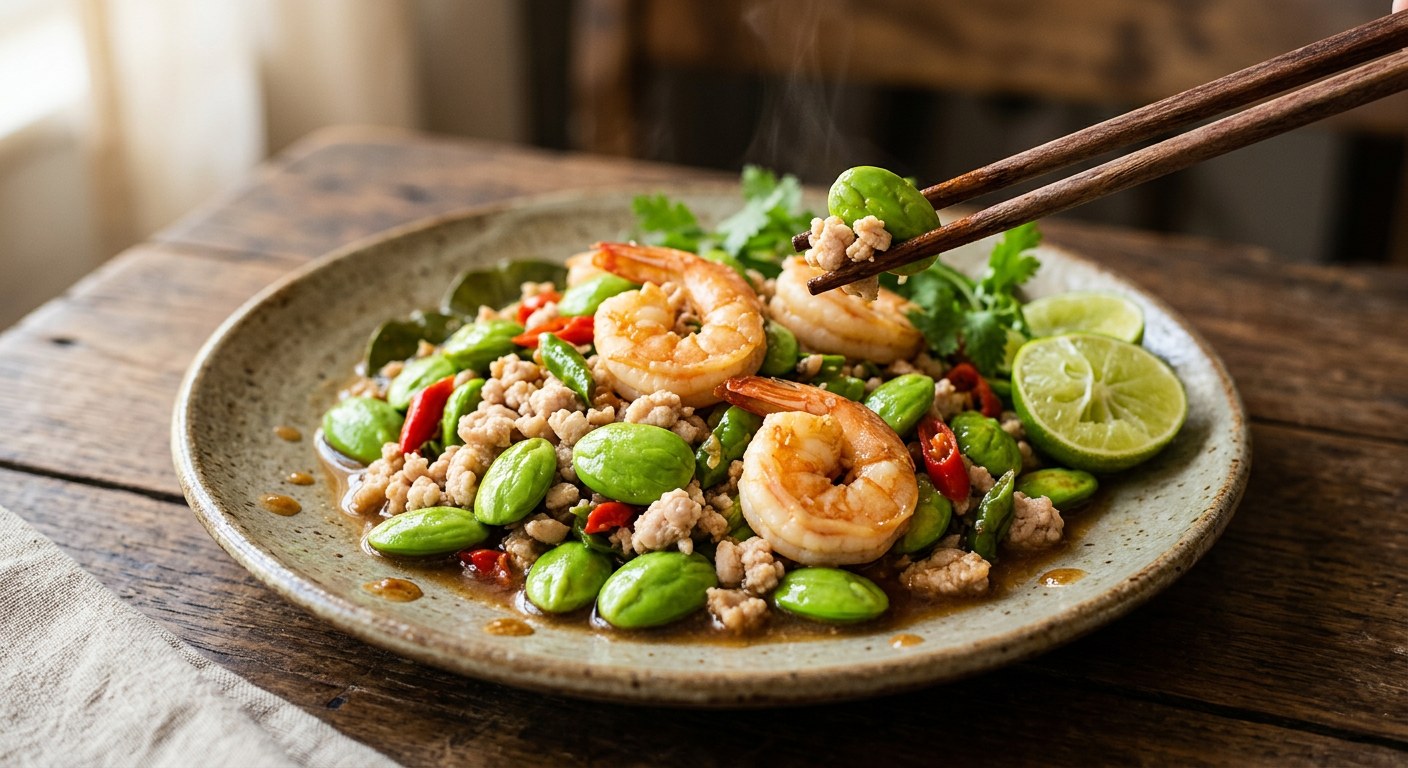
Sataw — the stink bean — flash-fried with shrimp paste, bird's eye chillies, pork and prawns. The southern Thai plate that clears the room, then empties the rice pot.
ผัดสะตอ is built on sataw — the stink bean, the southern vegetable that divides every table before a single bite is taken. Wongnai's home version is the classic shape of the dish: a paste of chillies, garlic, shallots and good shrimp paste fried until the whole kitchen knows, then minced pork, prawns, a quick toss of beans, and lime squeezed in over the heat of the pan.
The technique has two details worth keeping. The paste is pounded with a little sugar — the sugar helps the chillies break down under the pestle — and the beans go in last, fried only until just cooked, still with their crunch. Wongnai's author, a born southerner, is precise about the bean itself: satao kao, the pale, milder kind, over satao dan, the dark and aggressive one.
Then there is the other school of the dish. Pim's kitchen fries a seasoned nam phrik kapi — lime, fish sauce and palm sugar already worked into the paste — instead of a raw kapi paste. And the versions scale: Mahidol's institute kitchen counts thirty chillies for four people, while SiamKapi's guide is about fire control — medium-high heat, paste fried until fragrant but never burnt, beans never overcooked.
| Thai | English | Amount |
|---|---|---|
| สะตอข้าวแกะแล้ว | Sataw beans, shelled (satao kao) | 80 g |
| กุ้งแชบ๊วย แกะเปลือกไว้หางผ่าหลัง | Shrimp, peeled, tails on, deveined | 3 |
| หมูสับ | Minced pork | 80 g |
| กะปิเคยอย่างดี | Shrimp paste | ¾ tbsp |
| พริกขี้หนูสวน | Bird's eye chillies | 10 |
| กระเทียม | Garlic | 2 cloves (small) |
| หอมแดง | Shallots | 3 |
| น้ำตาลทราย | Sugar | 1 tbsp |
| น้ำปลา | Fish sauce | 2 tsp |
| น้ำมันหอย | Oyster sauce | 2 tsp |
| มะนาว | Lime | ½ |
| น้ำมันพืช | Vegetable oil | 1 tbsp |
| น้ำซุปหมู | Pork stock | 2 ladles |
The institute batch (Mahidol, for 4): 1 tbsp shrimp paste, 30 chillies, 4 garlic cloves, ½ tsp salt pounded coarse; 20 beans, 10 shrimp, 58 g pork loin, 5 shallots, 4 tbsp oil, 2 tbsp sugar, 2 tbsp lime juice, 3 tbsp oyster sauce. The nam phrik kapi version (Pim): ½ cup seasoned nam phrik kapi, 100 g sataw, 100 g minced pork, 8–10 shrimp, 1–2 tbsp each palm sugar, fish sauce and lime, ¼ cup water if the pan dries. The shrimp-only fry (Foodland): 200 g shrimp, 100 g sataw, 2 tbsp kapi, 5–10 chillies, 3–4 garlic, 2 shallots, 1 tsp sugar, 2 tbsp fish sauce — beans water-soaked first. The fire-control guide (SiamKapi): 1 cup sataw, 200 g shrimp, 1½ tbsp oyster sauce, 1 tbsp lime juice, 1 tsp sugar — hard beans blanched 20–30 seconds.
Raw paste or ready nam phrik kapi. Wongnai, Mahidol, Foodland and SiamKapi fry a raw kapi-chilli paste; Pim seasons the nam phrik kapi first — lime, fish sauce and palm sugar worked in — and fries that. The raw paste lets the shrimp paste bloom in the wok; the seasoned paste carries the whole flavour profile in from the start.
The oyster sauce. Mahidol stirs in a full 3 tablespoons, SiamKapi 1½, Wongnai 2 teaspoons — and Wongnai's author says to skip it entirely for the real southern taste. Foodland and Pim don't use it at all. It is the mainland sweetener creeping into a southern dish.
The lime. 2 tablespoons (Mahidol, and Pim's range), 1 tablespoon (SiamKapi), half a fruit (Wongnai), none (Foodland). But every source that uses it agrees on the moment: last, off the heat, so the sourness lands fresh.
The heat. Thirty chillies for four people (Mahidol), forty bird's eye plus six large red in Pim's nam phrik, ten (Wongnai), eight to twelve (SiamKapi), five to ten (Foodland). Southern heat is the point; the milder counts are the versions written for outsiders.
Taming the beans. Foodland soaks the sataw in water first to cut the bitterness; SiamKapi blanches only hard, old beans for 20–30 seconds; the rest trust the quick fry alone. Same goal — beans that are cooked but still crunch.
The sweetness. Mahidol takes 2 tablespoons of sugar, Wongnai 1, Foodland and SiamKapi a single teaspoon — SiamKapi's rule is that sweetness is only a hint, there to hold up the salt and heat, never to lead.
This recipe is translated from the following Thai-language sources. Where they disagree, we've said so.
1. Wongnai — "วิธีทำ! สะตอผัดกะปิกุ้งสด เมนูอาหารใต้ ทำง่าย ๆ แถมหรอยอย่างแรงนิ!" by ปูนแดง (the recipe used here) — wongnai.com
2. Mahidol University Institute of Nutrition — "ผัดสะตอกับกะปิใส่กุ้ง" (the 4-person institute batch) — inmu.mahidol.ac.th
3. ครัวบ้านพิม — "สะตอผัดน้ำพริกกะปิสามรส" (the seasoned nam phrik kapi version) — pim.in.th
4. SiamKapi — "สะตอผัดกะปิกุ้งให้อร่อยแบบครัวใต้: สูตรทำจริงและทริกคุมไฟ" (the fire-control guide) — siamkapi.com
5. Foodland — "สูตรอาหาร: ผัดสะตอกะปิกุ้งสด" (the shrimp-only fry with the water-soak) — foodland.co.th