Recipe · Thailand · The Fridge-Clearing Stir-Fry

Pad Phak Ruam (ผัดผักรวมมิตร)

Golden fried garlic, a handful of whatever vegetables the fridge has left, a splash of oyster sauce — the everyday vegetable stir-fry of Thai home cooking, fast and served crisp.

Pad Phak Ruam — Garlic fried golden, then vegetables and shrimp stir-fried fast over high heat and seasoned with oyster sauce and

The Stir-Fry That Clears the Fridge

ผัดผักรวมมิตร means stir-fried vegetables "all mixed together" — ruam mit is the same "mixed friends" phrase that names Thailand's classic mixed dessert. It is the default vegetable side dish of Thai home cooking, the one ordered without thought at every ahan tam sang (made-to-order) stall, and the recipe Thai cooks never actually follow, because the whole point is that it absorbs whatever the fridge has left. Pim, of the long-running Thai home-cooking blog ครัวบ้านพิม, opens her version by listing ten vegetables she found that week — kale, long beans, wood ear, onion, carrot, choy sum, chillies, kaffir leaves, basil — then applies the rule the whole dish hangs on: choose four to six kinds that get along, and no more.

The technique is a template, not a formula. Garlic goes in first and must go properly golden before anything else joins it — every one of our sources fries the garlic alone. Then protein, then the hard vegetables, then the soft, at the highest heat you can manage, seasoned with oyster sauce and thin soy sauce, sometimes a pinch of sugar. Pim finishes with a splash of stock for a slightly saucy, khlong kluk coating; Aroifin's precisely weighed one-serving version — 80 g shrimp, baby corn, sweet peas, carrot — prints its own nutrition on the page: 331 kcal with 23 g protein, on one tablespoon of oil. The problems Thai cooks actually solve are the ones Western recipes never mention: the raw green smell (men khiao) of brassicas, fixed by blanching the vegetables twice in boiling water, as Kapook's minced-pork version does, and colour — Kapook's shrimp version blanches only until the vegetables just change colour, then plunges them into ice water so they stay bright.

The dish has a second family too. Wongnai's chubbylawyer builds it meatless — dried shiitake soaked soft does the savoury work, the vegetables are blanched and dressed with an oyster-sauce gravy thickened with tapioca starch, poured over the plate rather than stir-fried in. And Pantip's Angelisa, republished in Kapook's 18-recipe roundup, runs it as clean food: chicken breast, olive oil, low-sodium fish sauce. Same name, same shape — garlic, vegetables, oyster-soy seasoning, high heat, served while the vegetables still fight back.
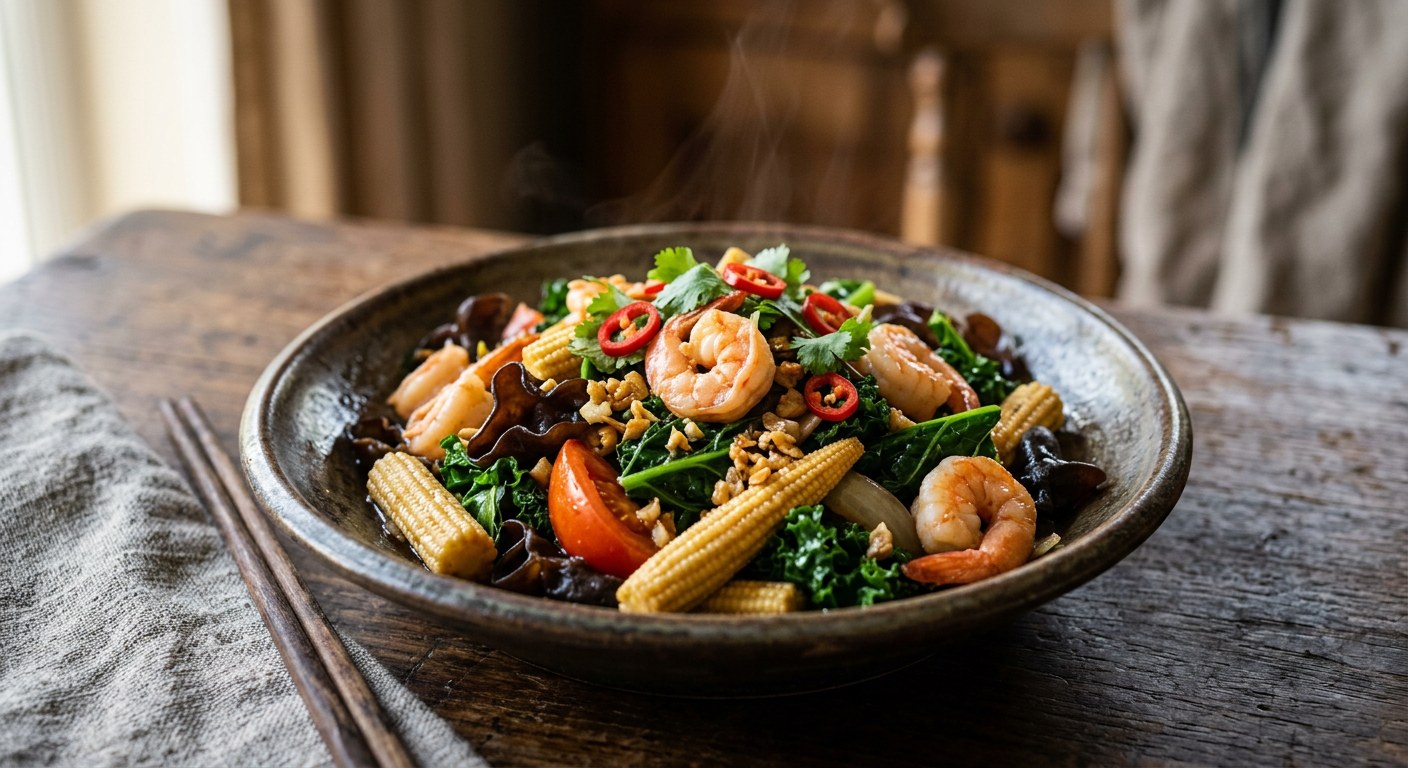
The Recipe (home version, from ครัวบ้านพิม)

ThaiEnglishAmount
ข้าวโพดอ่อนBaby corn6 small cobs
เห็ดหูหนูWood ear mushroom50 g
มะเขือเทศTomato1
คะน้าKale (kai lan)2 large stalks
หอมหัวใหญ่Onion½ large
กุ้งสดShrimp15
กระเทียมสับหยาบGarlic, coarsely chopped3–4 cloves
น้ำมันหอยOyster sauce~1 tbsp
ซีอิ๊วขาวThin soy sauce~1 tbsp
น้ำมันสำหรับผัดOil3 tbsp
น้ำซุปStock3–4 tbsp

The weighed batch (Aroifin): for one serving — 80 g shrimp, 70 g baby corn, 80 g sweet peas, 40 g carrot, 1 tbsp garlic, 1 tbsp rice bran oil, 1 tbsp soy sauce, 1 tsp oyster sauce, ½ tbsp seasoning powder, 1 tsp sugar, 2 tbsp water; 331 kcal, 23 g protein. The no-green-smell batch (Kapook, minced pork): cauliflower, broccoli and carrot blanched twice in boiling water, then fried with pounded Thai garlic and blanched seasoned minced pork, seasoned with seasoning powder, seasoning sauce, sugar and oyster sauce. The clean batch (Pantip's Angelisa via Kapook): chicken breast with olive oil, low-sodium fish sauce, thin soy and low-sodium oyster sauce. The meatless batch (Wongnai's chubbylawyer): choy sum, kai lan shoots, cauliflower and carrot blanched, shiitake fried with garlic, dressed with oyster sauce, seasoning sauce, sugar and a tapioca-starch gravy.

The Method

  1. The vegetables. Wash everything before cutting. Trim the baby corn and slice it in long zigzags; peel the kale stalks and keep the tender inner stems separate from the leaves; cut the wood ear bite-size, the tomato into six, the onion into big chunks. Shell and devein the shrimp — Pim's order, and it is why the dish cooks in five minutes.
  2. The garlic. Medium heat, about 3 tablespoons of oil, and the coarsely chopped garlic goes in alone. Fry it until properly golden — this is the base flavour of the whole dish, and no source skips the step.
  3. The shrimp. Add the shrimp while they still have their spring. Pim adds the baby corn and kale stems before the shrimp are fully done, so nothing overcooks; Aroifin's tip is the same idea made stricter — pull the shrimp at 70% done and return them at the end.
  4. The fire. Stir once, then raise the heat to high and add everything else. The vegetables are done when they are bright and still crisp; if you prefer them soft, Pim's fix is simply to stir a little longer, not to add water.
  5. The finish. Season with oyster sauce and thin soy sauce — about a tablespoon of each — and add the splash of stock for the saucy coating. Stir just until it comes together and off the heat. Serve immediately with rice; the vegetables should still crunch.

Where Thai Sources Disagree

Blanch first, or straight into the wok? Pim and Aroifin stir-fry everything from raw. Kapook's two versions blanch first — twice, to kill the raw green smell, or once plus an ice bath, to hold the colour. Wongnai's chubbylawyer blanches everything and then doesn't stir-fry the vegetables at all: the hot sauce is poured over them.

The protein. Shrimp in Pim, Aroifin and Kapook's dedicated shrimp recipe; minced pork in Kapook's household version; chicken breast in Angelisa's clean-food version; nothing but shiitake in chubbylawyer's. Kapook's shrimp article says it outright: no shrimp? use pork or chicken. The dish doesn't care.

The seasoning. The common core is oyster sauce plus thin soy. Aroifin and Kapook's minced-pork version add seasoning powder (MSG-style); Angelisa runs the low-sodium line with fish sauce; chubbylawyer adds sugar and a tapioca-starch slurry, turning the seasoning into a real gravy.

Saucy or dry. Pim's splash of stock makes the finish wet and glossy; Aroifin adds water only if the pan threatens to dry out; chubbylawyer's thickened sauce is deliberately soupy, plated over blanched vegetables. All three are called the same dish.

The oil. Olive oil only in the clean-food version; rice bran oil in Aroifin's weighed recipe (with a note that a little sesame oil adds aroma); plain vegetable oil everywhere else.

How Western Versions Get It Wrong

UK Ingredient Notes

Sources

This recipe is translated from the following Thai-language sources. Where they disagree, we've said so.

1. ครัวบ้านพิม (Pim's Kitchen) — "ผัดผักรวมมิตร" (the recipe used here) — pim.in.th

2. Kapook — "ผัดผักรวมหมูสับ เมนูผักอร่อยง่ายกินเพลินไม่เหม็นเขียว" by คุณหมีซี้ด (the double-blanch trick) — cooking.kapook.com

3. Kapook — "ผัดผักรวมมิตรกุ้ง สูตรเด็ดผักสวยกุ้งเด้งอร่อยได้สุขภาพ" (the ice-bath colour trick) — cooking.kapook.com

4. Kapook — "18 เมนูผัดผัก รวมสูตรเมนูผักหอมอร่อยย่อยง่าย", recipe by Pantip member Angelisa (the clean-food version) — cooking.kapook.com

5. Wongnai — "สูตร ผัดผักรวมมิตร" by chubbylawyer (the meatless starch-gravy version) — wongnai.com

6. Aroifin — "วิธีทำ ผัดผักรวมมิตร กุ้งเด้ง! ทำง่าย ได้ประโยชน์เต็ม ๆ" by mimi (the weighed recipe and nutrition) — aroifin.com

Johnny Tiger
Johnny researches and translates Thai recipes from Thai-language sources — chefs, restaurants and home cooks in Thailand — and publishes them with their sources cited. No westernised shortcuts, no invented steps.