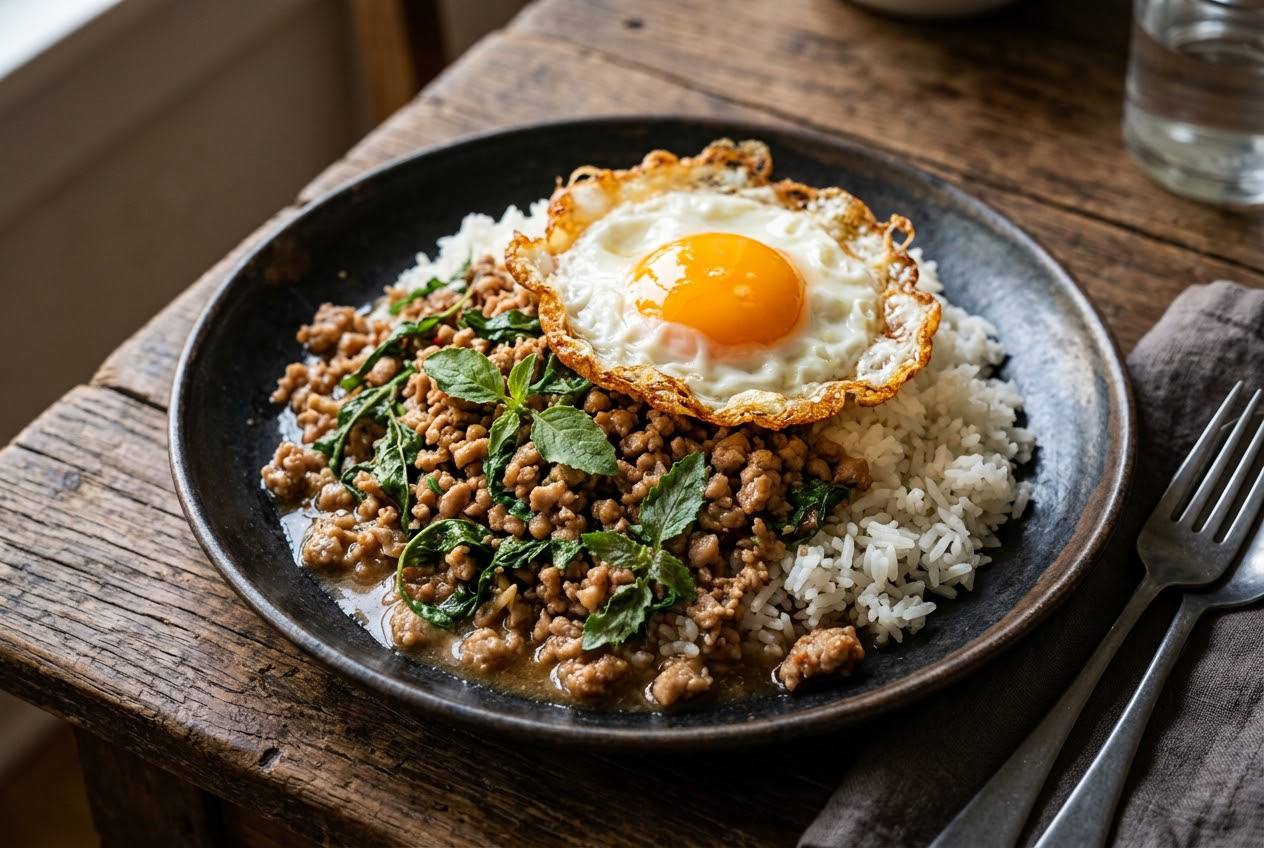
Thailand's favourite thing to eat, any hour of the day. Real holy basil, maximum-heat wok, and a fried egg with crispy edges and a yolk that runs into the rice.
Forget pad thai and tom yum — the dish Thais actually order most is pad krapow, a one-plate stir-fry of minced meat, garlic, chillies and holy basil over rice with a fried egg. It emerged around 1947, in the era of one-plate-meal promotion: Chinese stir-fry technique married to Thai ingredients. In 2020, the Michelin Guide asked Chef Ton (Thitid Tassanakajohn) — of Baan, sibling restaurant to one-star Le Du — for his recipe, and he handed over the lot, including the two spices he calls his secret: roasted coriander seed and cumin, sprinkled at the end.
The oldest documented recipe is from a cremation memorial cookbook printed in 1968. It has no oyster sauce, no vegetables, no egg — a paste of coriander root, pepper, dried ginger, chillies, garlic and shallots fried in lard. Long beans and baby corn in "pad krapow" are shop filler, added to pad out the meat — and Thailand's half-million-member krapow lovers' club does not approve.
The name is the leaf. กะเพรา is holy basil (Ocimum tenuiflorum) — a different plant from the sweet basil (โหระพา) western recipes quietly substitute. Thai cooks are blunt: if it isn't holy basil, it isn't pad krapow.
| Thai | English | Amount |
|---|---|---|
| เนื้อสับ | Minced meat — Chef Ton uses dry-aged beef; pork mince with a bit of fat is the street classic | 120 g |
| น้ำมันหอย | Oyster sauce | 2 tbsp |
| น้ำปลา | Fish sauce | ½ tbsp |
| ซอสถั่วเหลือง | Soy sauce | ½ tbsp |
| น้ำตาลปี๊บ | Palm sugar | ½ tsp |
| กระเทียมสับ | Garlic, chopped | 5 g |
| พริกขี้หนู | Bird's eye chillies | 5 |
| ใบกะเพรา | Holy basil leaves — a full handful | 10 g |
| ลูกผักชีคั่ว + ยี่หร่าป่น | Roasted coriander seed + ground cumin, to finish | a pinch |
| น้ำมันปรุงอาหาร | Cooking oil | — |
| ข้าวสวย | Jasmine rice | 1 plate |
| ไข่ | Egg | 1 |
The basil. Holy basil is the dish. Pantip cooks allow sweet basil in an emergency — but insist it's then a different dish. No source pretends otherwise.
The meat. Pork mince with some fat is the street #1 (the fat renders into the chilli-garlic). Chef Ton's personal favourite is dry-aged beef. Chicken is common. All three are authentic.
Oyster sauce. Standard in every modern recipe; absent from the 1968 original, which seasoned with fish sauce and sugar alone.
Vegetables. The 1968 original has none. Long beans, baby corn and onion appear in modern shop versions as filler — the krapow community's pet hate.
The cumin-coriander finish. Chef Ton's signature, revealed to Michelin. Not standard; it's the upgrade.
MSG. In the 1968 original. Modern chef recipes — Chef Ton's included — omit it.
This recipe is translated from the following Thai-language sources. Where they disagree, we've said so.
1. Michelin Guide Thailand (14 Aug 2020) — "ผัดกะเพราสูตร (ไม่) ลับ จานเด็ดของเชฟต้น-ธิติฏฐ์ ทัศนาขจร แห่งร้านบ้าน" — Chef Ton, Baan / Le Du — guide.michelin.com
2. Thairath (13 Oct 2021) — "เปิดสูตร ผัดกะเพราโบราณ ต้นตำรับที่แท้จริง ไม่ใส่ถั่วฝักยาว" — the 1968 original recipe — thairath.co.th
3. Pantip thread 44168845 — "เปิดคัมภีร์ ผัดกะเพรา ที่ถูกต้อง" (wok technique, the perfect egg) — pantip.com
4. Pantip thread 37240856 — "ใบโหระพาใช้ผัดแทนกะเพราได้ด้วยหรอ" (holy vs sweet basil debate) — pantip.com