Recipe · Thailand · The Pounded Mackerel Dip
Nam Phrik Pla Too (น้ำพริกปลาทู)
Mackerel, roasted chillies, garlic and shallots pounded together into the fish dip of the Thai lunch table — pla ra optional, the flavour not.
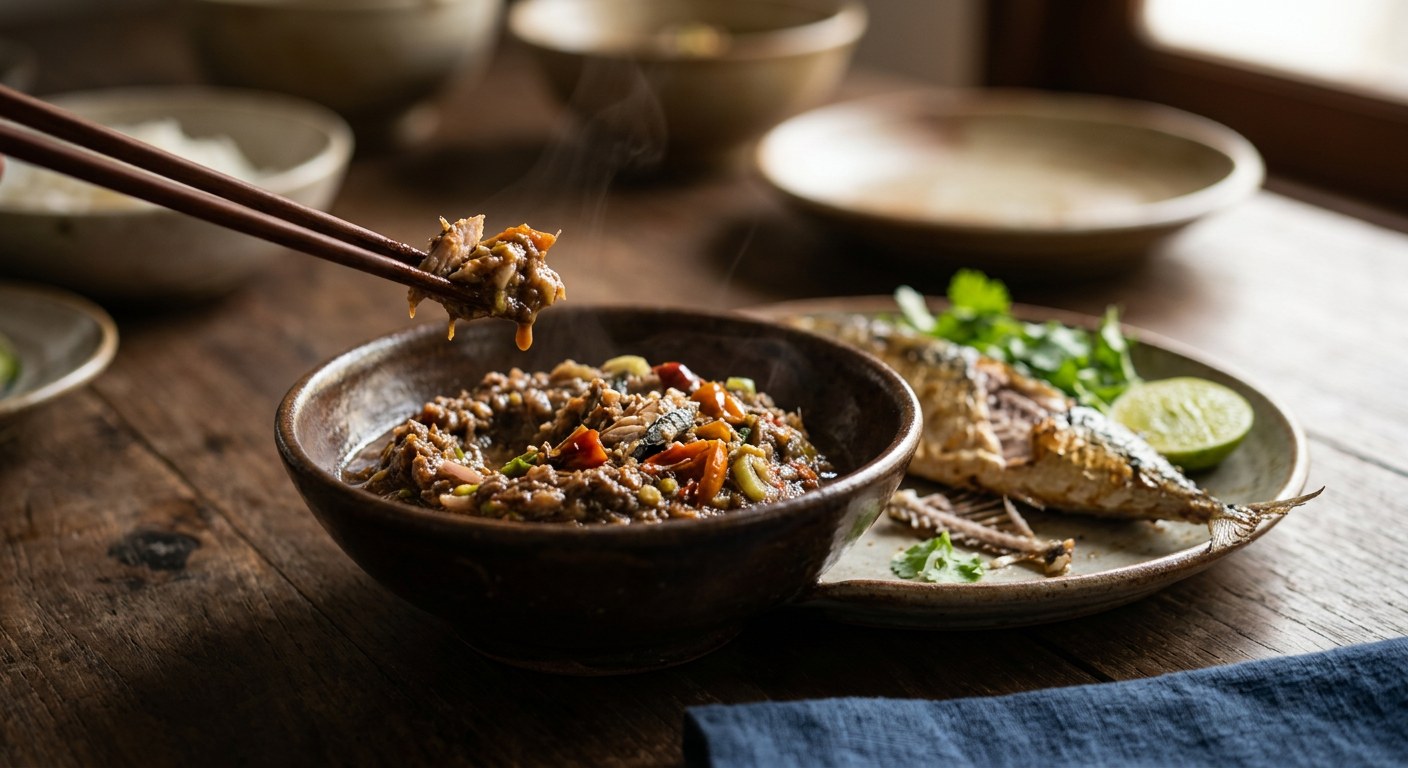
Mackerel, roasted chillies, garlic and shallots pounded together into the fish dip of the Thai lunch table — pla ra optional, the flavour not.
น้ำพริกปลาทู is the nam phrik where the mackerel doesn't sit on the side — it goes into the mortar itself. Pla too, the short-bodied mackerel that is Thailand's cheap everyday fish, gets steamed, grilled or fried, boned, and pounded with roasted aromatics into a dip that is half dip and half fish. Kapook's pitch is the diet-friendly one: a protein-heavy chilli dip, hot and sour, eaten with raw or blanched vegetables, or over hot rice. And it has a cousin name — ป่นปลาทู (pon pla too), the pla-ra-rich version Wongnai calls increasingly hard to find in restaurants.
The craft is all in the roast. Kapook's plain version dry-roasts garlic, shallots and chillies in a hot pan until lightly charred before they reach the mortar — the char carries the whole dip. The more elaborate versions take it further: Wongnai's and LunnyToon's recipes grill everything over the fire and then peel the burnt skins off before pounding. TrueID scales up instead — 150 g of garlic and 150 g of shallots to 200 g of fish, a garlic-led batch meant to be eaten with hot rice or sticky rice.
Then there are the seasoning schools. The pla ra school runs from a single tablespoon (Wongnai's version) to a simmered ladleful (Kapook's pla ra version) to a full half cup in the pon pla too. The clean school — Kapook's plain version and LunnyToon's — seasons with nothing but fish sauce, lime and palm sugar. And the second-cook school: Kapook's dry-stir-fried version pounds everything fine and then fries the paste in the pan until it smells like the market.
| Thai | English | Amount |
|---|---|---|
| ปลาทูย่างหรือนึ่ง | Mackerel, grilled or steamed | 1 fish |
| กระเทียม | Garlic | 1 tbsp |
| หอมแดงหั่นบาง | Shallots, sliced | 2 |
| พริกขี้หนูแดงซอย | Red bird's eye chillies, sliced | 5–10 |
| น้ำต้มสุก | Boiled water | 3 tbsp |
| น้ำมะนาว | Lime juice | 2 tbsp |
| น้ำปลา | Fish sauce | 1 tbsp |
| น้ำตาลปี๊บ | Palm sugar | ½ tbsp |
| ผักสดหรือผักลวก | Fresh or blanched vegetables | to serve |
The grilled-and-peeled version (Wongnai, and LunnyToon's near-twin): flesh of 2–3 fried mackerel, 2 banana chillies, 10 red jinda chillies, 2 red spur chillies, 5 garlic cloves, 3–6 shallots, 1 lime, ½ tbsp fish sauce, ¼–½ tbsp palm sugar, salt — aromatics charred and peeled first, 1 tbsp pla ra optional. The pla ra batch (TrueID): 200 g mackerel, 150 g garlic, 150 g shallots, 100 g chillies, 1½ tbsp pla ra, 1 tbsp fish sauce, 2½ tbsp lime juice. The dry-stir-fried version (Kapook): 9 grilled mackerel, 2 tbsp banana-leaf-grilled shrimp paste, roasted sliced lemongrass, grilled shallots, red chillies and garlic — pounded fine, then fried in the pan.
Fried, grilled, steamed or boiled. Wongnai and LunnyToon fry the mackerel; Kapook's plain version grills or steams it; Kapook's pla ra version boils it in the two cups of water that later become the dip's liquid; TrueID lists steamed mackerel and fries it anyway.
Pla ra or not. The clean school — Kapook's plain version and LunnyToon — seasons with fish sauce alone. The pla ra school runs from 1 tbsp (Wongnai) to 1½ tbsp (TrueID) to 2–3 ladles (Kapook's pla ra version) to a full half cup in the pon pla too — which is the dish's other name.
Peel the char or keep it. Wongnai and LunnyToon peel the burnt skins off the grilled aromatics before pounding; Kapook and TrueID pound the charred aromatics in whole, skins and all.
The second cooking. Kapook's dry-stir-fried version pounds everything fine and then fries the paste in the pan until fragrant; every other version is served straight from the mortar.
The garlic ratio. One tablespoon to a fish (Kapook's plain version) against TrueID's 150 g of garlic and 150 g of shallots to 200 g of fish. The big batch is garlic-led; the home bowl is chilli-led.
Sugar or none. Palm sugar in the plain and grilled versions, white or brown sugar in the dry-fried and tuna versions — and TrueID's pla ra batch uses no sugar at all.
Fresh fish or canned. Both Kapook's tuna version and Wongnai's pon pla too swap in canned tuna — the pantry shortcut the sources offer themselves.
This recipe is translated from the following Thai-language sources. Where they disagree, we've said so.
1. Kapook — "4 สูตรน้ำพริกปลาทู อาหารไทยเติมโปรตีน รสแซ่บหอมอร่อยจิ้มเพลิน" (the recipe used here is the plain no-pla-ra version; the article's other recipes come from Pantip members ตะโกครับ and bangbuatong60d) — cooking.kapook.com
2. Wongnai — "วิธีทำ 'น้ำพริกปลาทู' เมนูน้ำพริกหอมนัวถูกใจ แซ่บซี้ดจนต้องร้องตะโกน" (the grilled-and-peeled version, by หลุมดำผู้ดูดกลืน) — wongnai.com
3. TrueID Food — "สูตรอาหาร วิธีทำ น้ำพริกปลาทู ป่นปลาทู ใส่น้ำปลาร้า ปรุงง่าย ทำไว อร่อยนัว" (the big-batch pla ra version, from the กินได้อร่อยด้วย channel) — food.trueid.net
4. Wongnai — "สูตร น้ำพริกปลาทู พร้อมวิธีทำโดย LunnyToon" (the home version with the fire-grill and the peeling step) — wongnai.com
5. Wongnai — "วิธีทำ 'ป่นปลาทู' เมนูอาหารไทยหอมปลาร้า ใครลองก็บอกแซ่บนัวเกินคาด" (pon pla too, the pla-ra-rich variant) — wongnai.com