Recipe · Thailand · The Ancient Sweet That Kept Its Name

Khao Tom Mat (ข้าวต้มมัด)

Sticky rice stir-fried in coconut cream until it gleams, wrapped in banana leaves around a banana and black beans, steamed for hours — a market sweet so old its name records the day it stopped being boiled.

Khao Tom Mat — Glutinous rice stir-fried in coconut cream until glossy, wrapped in banana leaves around nam wa banana and black

The Sweet Named After a Cooking Method

ข้าวต้มมัด is a name in three parts: khao (rice), tom (boiled) and mat (tied). Yet almost nothing about the dish is boiled. Kapook records the older name, ข้าวต้มผัด — khao tom phad, "stir-fried boiled rice" — and the stir is the thing: glutinous rice is fried in coconut cream until it gleams before it ever meets a banana leaf. The Pantip seller's shop, ร้านข้าวต้มผัด แม่สุดใจ, still trades under the old name, and the formula she shares is built around that gloss: a ka thang wok so the rice stays fragrant and keeps longer, and the cream "cracked" — simmered until the oil separates — before the rice goes in.

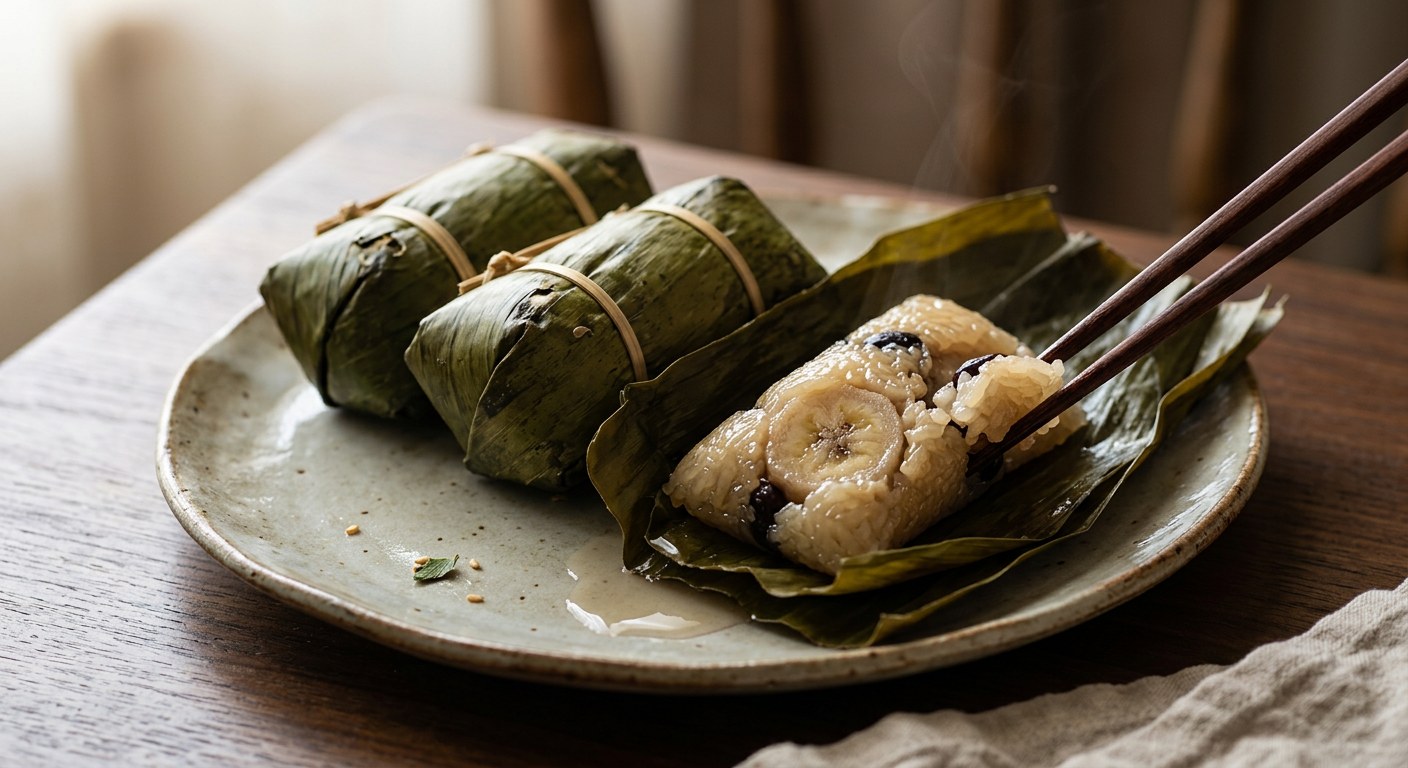
Inside the leaf there is a banana, always — nam wa, the small starchy Thai banana, not a dessert banana — and, in most versions, black beans. The parcel is folded into a triangle, pleated at both ends like an origami boat, and joined to a second parcel so the pair can be tied together with soaked bamboo strips. Kapook's classic recipe tells you it is sold at every market in Thailand, and its taro-stuffed cousin (ไส้เผือก) is a one-word substitution.

The method tolerates everything except haste. Wongnai's "ancient" version makes the coconut milk by hand from two fresh coconuts over a charcoal fire, sweetens a kilo and a half of rice with a mere two tablespoons of sugar, and re-steams the leftovers the next day. Rin's Cookbook, the Kapook recipe with half a million reads, steams for up to two hours and warns that the only way to ruin the rice is to stir it too hard — the grains snap, and the sweet turns to porridge before it reaches the leaf.

The Recipe (home version, from Rin's Cookbook via Kapook)

ThaiEnglishAmount
ข้าวเหนียวเขี้ยวงูดิบGlutinous rice, raw2 cups
ถั่วดำBlack beans½ cup
หัวกะทิCoconut cream3 cups
เกลือป่นSalt2 tsp
ใบเตยPandan leavesa few
น้ำตาลทรายSugar1½ cups
กล้วยน้ำว้าNam wa bananas16–18
ใบตองชั้นใน ขนาด 6x8 นิ้วBanana leaves, inner6×8 in
ใบตองชั้นนอก ขนาด 8x9 นิ้วBanana leaves, outer8×9 in
ตอก แช่น้ำ 2-3 ชั่วโมงBamboo strips, soaked 2–3 hoursfor tying

The market seller's batch (TrueID, ครัวพิศพิไล): 500 g new-crop glutinous rice soaked 4 hours, 500 ml coconut milk, 230 g sugar, 2 tsp salt — and a filling of steamed mung beans and toasted white sesame instead of black beans, with a pinch of salt rubbed on the cut banana so it never blackens. The shop formula (Pantip, แม่สุดใจ): 2 kg rice, 2 kg coconut milk squeezed from 1 kg grated coconut, 400 g sugar, 50 g salt, 2 bunches of banana, 200 g black beans — cream "cracked" first, then a 90-minute steam. The ancient bowl (Wongnai, GopOpOp): 1.5 kg rice soaked in hot water just 30 minutes, hand-squeezed coconut milk, only 2 tbsp sugar — nearly unsweetened, as the old versions were.

The Method

  1. The soak. Wash the glutinous rice twice and soak it 4 hours or overnight; the black beans soak overnight too, then boil 30–40 minutes until tender. Pantip's shop soak is 4–6 hours, and Wongnai's ancient version gets away with 30 minutes in hot water.
  2. The cream. Heat the coconut cream with the salt over medium heat, stirring in one direction, pandan leaves in. When it boils, add the rice and stir gently — Rin's rule: stir in one direction with a soft spatula, never hard, or the grains break and the rice turns to mush.
  3. The gloss. After 2–3 minutes the rice has drunk the cream. Stir 5–6 minutes more, drop the heat, and cook until nearly dry; then add the sugar and keep stirring until the rice is glossy. That shine is the whole point of the ผัด in the old name.
  4. The fold. Lay two leaves shiny-sides together. Beans first, a spoon of rice, a banana half, another spoon of rice on top. Fold into a triangle, fold the ends down, pleat and tuck the sides — then make two parcels and join them inner-side to inner-side, so they tie together as one.
  5. The steam. Tie tightly with soaked bamboo strips in two bands and steam over boiling water 1 h 45 min to 2 hours. TrueID's seller gives the range as 1–2 hours; Pantip steams 90 minutes; Kapook's simpler classic is done in 40. The rice inside the leaf finishes cooking by steam — nothing is boiled, the name notwithstanding.

Where Thai Sources Disagree

The beans. Black beans are the default — Kapook's two recipes and Pantip's shop all use them. TrueID's selling recipe swaps in steamed mung beans with toasted white sesame, and Wongnai's ancient version skips beans entirely: banana alone in the rice.

The sweetness. The gap is enormous. Rin's Cookbook sugars at 1½ cups per 2 cups of rice; TrueID at 230 g per 500 g; Pantip's shop at 400 g per 2 kg — deliberately "not too sweet" for customers who don't eat sugar. Wongnai's ancient version uses 2 tablespoons for 1.5 kg, a sweet you can barely call sweet.

The steam. 40 minutes (Kapook classic) against 1 h 45 min – 2 hours (Rin's Cookbook), with Pantip at 90 and Wongnai at 45–60. The deciding variables are parcel size and how far the stir-fry took the rice before wrapping — bigger parcels, wetter rice, longer steam.

The rice. Rin's specifies เขี้ยวงู, snake-fang glutinous rice; Kapook's classic says plain ข้าวเหนียวขาว; TrueID's seller wants ข้าวเหนียวใหม่, new-crop rice, which drinks the cream differently from old rice.

The tie. Bamboo strips (ตอก) soaked 2–3 hours in Rin's and Pantip's versions; TrueID allows กาบกล้วย, strips of banana stalk, soaked overnight; Kapook's classic is happy with food-safe string.

The name. Kapook and Pantip both record ข้าวต้มผัด as the ancient name, and Pantip's shop still uses it. The "boiled" in the modern name is a fossil — every source stirs in cream and steams in leaf.
How Western Versions Get It Wrong

UK Ingredient Notes

Sources

This recipe is translated from the following Thai-language sources. Where they disagree, we've said so.

1. Kapook Cooking — "ข้าวต้มมัด สูตรขนมไทยหวานมันอร่อยมัดใจ" by Rin's Cookbook (Rin Silpachai) (the recipe used here) — cooking.kapook.com

2. Kapook Cooking — "ข้าวต้มมัด ขนมไทยโบราณที่ไม่ควรพลาด" (the ancient name ข้าวต้มผัด and the 40-minute version) — cooking.kapook.com

3. TrueID Food — "กำไรงาม ! แจกสูตร ข้าวต้มมัด ไส้กล้วย อร่อย หอมนุ่ม ทำง่าย" by ครัวพิศพิไล (the mung-bean and sesame batch) — food.trueid.net

4. Pantip — "แจกสูตร วิธีทำข้าวต้มผัด หรือ วิธีทำข้าวต้มมัด ข้าวต้มมัดสูตรสร้างรายได้ สร้างอาชีพ" by ครัวเตาถ่าน Local Kitchen, from the shop ข้าวต้มผัด แม่สุดใจ (the commercial formula) — pantip.com

5. Wongnai — "ข้าวต้มมัดโบราณ" by GopOpOp (the hand-squeezed, nearly unsweetened version) — wongnai.com

Johnny Tiger
Johnny researches and translates Thai recipes from Thai-language sources — chefs, restaurants and home cooks in Thailand — and publishes them with their sources cited. No westernised shortcuts, no invented steps.