Recipe · Thailand · Durian-Season Sticky Rice

Khao Niew Durian (ข้าวเหนียวทุเรียน)

Sticky rice steamed, then munned with warm salted coconut cream and pandan — topped with durian and a palm-sugar coconut sauce. Mango sticky rice's heavier, louder cousin.

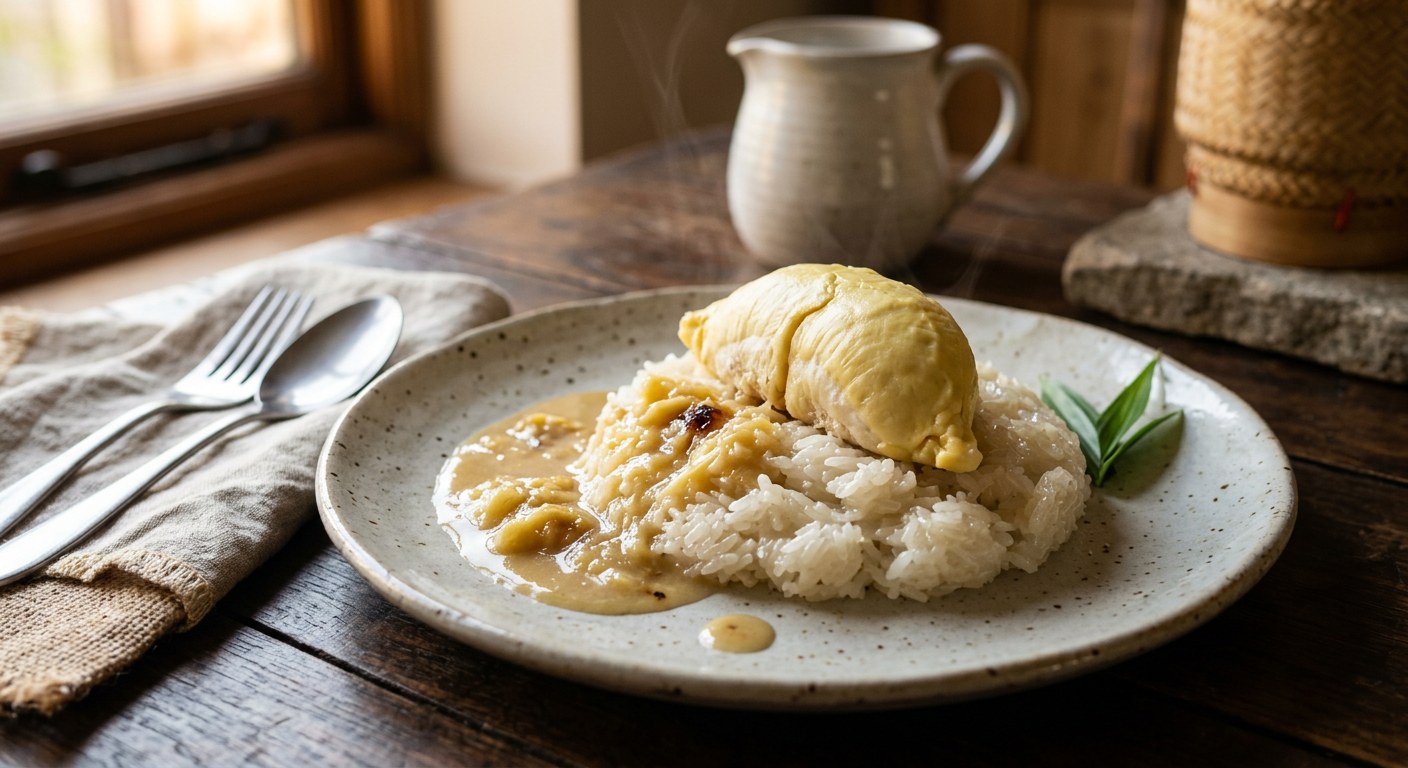
Khao Niew Durian — Kiew ngu sticky rice steamed and munned with warm salted coconut cream, served with durian — some mashed into

The Rice Durian Season Owns

ข้าวเหนียวทุเรียน is what the mango sticky rice stall sells for the three months of durian season — TrueID's MEEKAO dates it from late March, running two to three months. The dish is two things layered: khao niew mun, sticky rice munned with sweet-salty coconut cream, and durian — Thailand's king of fruit — either stewed gently into a coconut-palm-sugar sauce or laid on top in fat fresh pieces.

The detail every Thai source insists on before anything else is the rice. Aroifin's chef names ข้าวเหนียวเขี้ยวงู — kiew ngu, the slender "snake-fang" grain — the only variety that stays soft overnight instead of hardening in the fridge, and adds an old-timer's step western recipes never mention: scrub the raw grains with สารส้ม, alum, to make them glossy. Kapook and MEEKAO use the same alum but dissolve it into the soaking water instead of scrubbing — three hours' soak at least, then steam.

The other half of the craft is the mun: the coconut cream, sugar, salt and pandan are warmed until just hot — never boiled, or the cream แตกมัน, splits into oil and water — then folded into the hot rice and left under a lid for anywhere from ten minutes (MEEKAO, stirred and repeated) to a full hour (Aroifin), until the grains drink the cream. And the salt is not a pinch: Aroifin uses four teaspoons across the recipe, because salt is what cuts the durian's fat. Wongnai's home cook skips the sauce entirely and stews a whole durian into sweetened coconut milk over black sticky rice, and TrueID's ครัวพิศพิไล turns the durian husk itself into the bowl — mun rice stuffed inside, steamed mung beans on top.
The Recipe (from Aroifin, chef เจิน)

ThaiEnglishAmount
ข้าวเหนียวเขี้ยวงูKiew ngu sticky rice500 g
สารส้มก้อนAlum (for scrubbing the rice)1 lump
หัวกะทิCoconut cream1,000 ml
น้ำตาลทรายSugar120 g
น้ำตาลปี๊บPalm sugar120 g
เกลือSalt4 tsp
ใบเตยPandan leaves6 leaves
ทุเรียนDurian1 fruit, the best segments

The whole durian in the sauce (Kapook): for 500 g white sticky rice — 350 ml fresh-pressed coconut milk, 200 g sugar and 2 tsp salt in the mun; the sauce is 2 cups coconut milk, 100 g palm sugar and ½ tsp salt, with 500 g of torn ripe durian added at the first boil. The caramel-first sauce (TrueID, MEEKAO): mun of 500 g coconut cream, 220 g sugar, 1 tsp salt and 6–7 pandan leaves; the sauce melts 120 g coconut sugar until it darkens and smells toasted before the 500 g coconut cream and 4–5 durian segments go in. The black-rice version (Wongnai, Kao Infinity): 500 g black sticky rice soaked overnight, steamed, served under 1 kg coconut milk boiled with 700 g sugar, 2 tsp salt and a whole durian until thickened. The stuffed version (TrueID, ครัวพิศพิไล): 250 g rice mun-ed with 250 ml coconut milk, 150 g sugar and 1 tsp salt, plus 100 g steamed split mung beans, packed into halved durians.

The Method

  1. Prep the rice. Wash the sticky rice, scrub gently with the alum until the grains shine — Aroifin's trick for a glossy finish — then soak about 1 hour. Kapook dissolves the alum in the soak water instead and leaves it at least 3 hours; both work.
  2. Steam with pandan. Set the steamer over water with pandan leaves in it and steam the rice 30 minutes, or until cooked through. Kapook steams 20 minutes for its 500 g batch.
  3. The mun sauce. Warm the coconut cream with the sugar, salt and pandan over a low flame until just hot. Aroifin's warning stands for every step of this dish: if it boils, the cream แตกมัน — splits into oil and water and the sauce is ruined.
  4. Mun the rice. Fold the warm sauce into the hot rice, cover and leave 1 hour, opening to stir once or twice. MEEKAO's quicker cycle: cover 10–15 minutes, stir, repeat until the rice will take no more. The rice must drink the cream, not swim in it.
  5. The durian. Open the fruit, mash some of the flesh for the sauce and keep the biggest pieces whole for the top.
  6. The sauce. Over low heat warm coconut cream with salt, palm sugar and pandan, then stir in the mashed durian and heat it just through — off the stove the moment it is warm. MEEKAO melts the palm sugar first until it smells caramelised; Kapook holds the durian at a gentle bubble. Never boil it long: the aroma is the point.
  7. Assemble. Rice in the bowl, durian sauce ladled over, the big pieces on top, and a last drizzle of thick coconut cream. ครัวพิศพิไล's alternative: stuff the mun rice into halved durian husks and top with steamed split mung beans.

Where Thai Sources Disagree

Where the durian goes. Kapook and MEEKAO cook all of the durian into the coconut sauce. Aroifin mashes only part of it into the sauce and serves the best pieces fresh on top. Wongnai stews a whole durian into sweetened coconut milk over black rice. ครัวพิศพิไล skips the sauce and serves fresh durian as the bowl itself.

The rice. Four sources use white kiew ngu sticky rice. Wongnai's home cook uses ข้าวเหนียวดำ, black sticky rice — a different dish in colour and chew.

The alum. Aroifin scrubs the dry grains with a lump of alum for gloss; Kapook and MEEKAO stir pounded alum into the soaking water and rinse. ครัวพิศพิไล and Wongnai skip it altogether — ครัวพิศพิไล steeps its rice in boiled water for 10 minutes instead.

The sugar. Aroifin splits the sweetness: granulated sugar in the mun, palm sugar in the sauce. Kapook's mun is granulated only, palm sugar only in the sauce. MEEKAO uses coconut sugar in the sauce and caramelises it until dark and fragrant before the cream goes in — the richest of the three.

The salt. Aroifin's 4 tsp across the recipe is by far the heaviest hand; Kapook totals 2½ tsp, MEEKAO 2 tsp. All agree salt is structural, not seasoning.

The mung beans. Only ครัวพิศพิไล adds steamed split mung beans — the classic khao niew mun topping that most khao niew durian recipes leave out.

How Western Versions Get It Wrong

UK Ingredient Notes

Sources

This recipe is translated from the following Thai-language sources. Where they disagree, we've said so.

1. Aroifin — "วิธีทำ ข้าวเหนียวทุเรียน สูตรข้าวนุ่มเรียงเม็ด หอมมันกะทิ" by เชฟเจิน (the recipe used here) — aroifin.com

2. Kapook — "ข้าวเหนียวทุเรียนน้ำกะทิ หวานอร่อย กลิ่นหอมชวนชิม" (the all-in-the-sauce version) — cooking.kapook.com

3. TrueID Food — "เมนูหน้าร้อน! แจกสูตร ข้าวเหนียวทุเรียนน้ำกะทิ" by MEEKAO (the caramel-first sauce) — food.trueid.net

4. TrueID Food — "ตามรอยเมนูดัง! สูตรทำ ทุเรียนไส้ข้าวเหนียว" by ครัวพิศพิไล (the stuffed-durian version) — food.trueid.net

5. Wongnai — "สูตร ข้าวเหนียวทุเรียน" by Kao Infinity (the black sticky rice version) — wongnai.com

Johnny Tiger
Johnny researches and translates Thai recipes from Thai-language sources — chefs, restaurants and home cooks in Thailand — and publishes them with their sources cited. No westernised shortcuts, no invented steps.