Recipe · Thailand · The Nine-Layer Sweet
Khanom Chan (ขนมชั้น)
White and pandan-green batter steamed one thin layer at a time until the cake peels apart like pages — soft, chewy, fragrant, and built nine layers tall for luck.
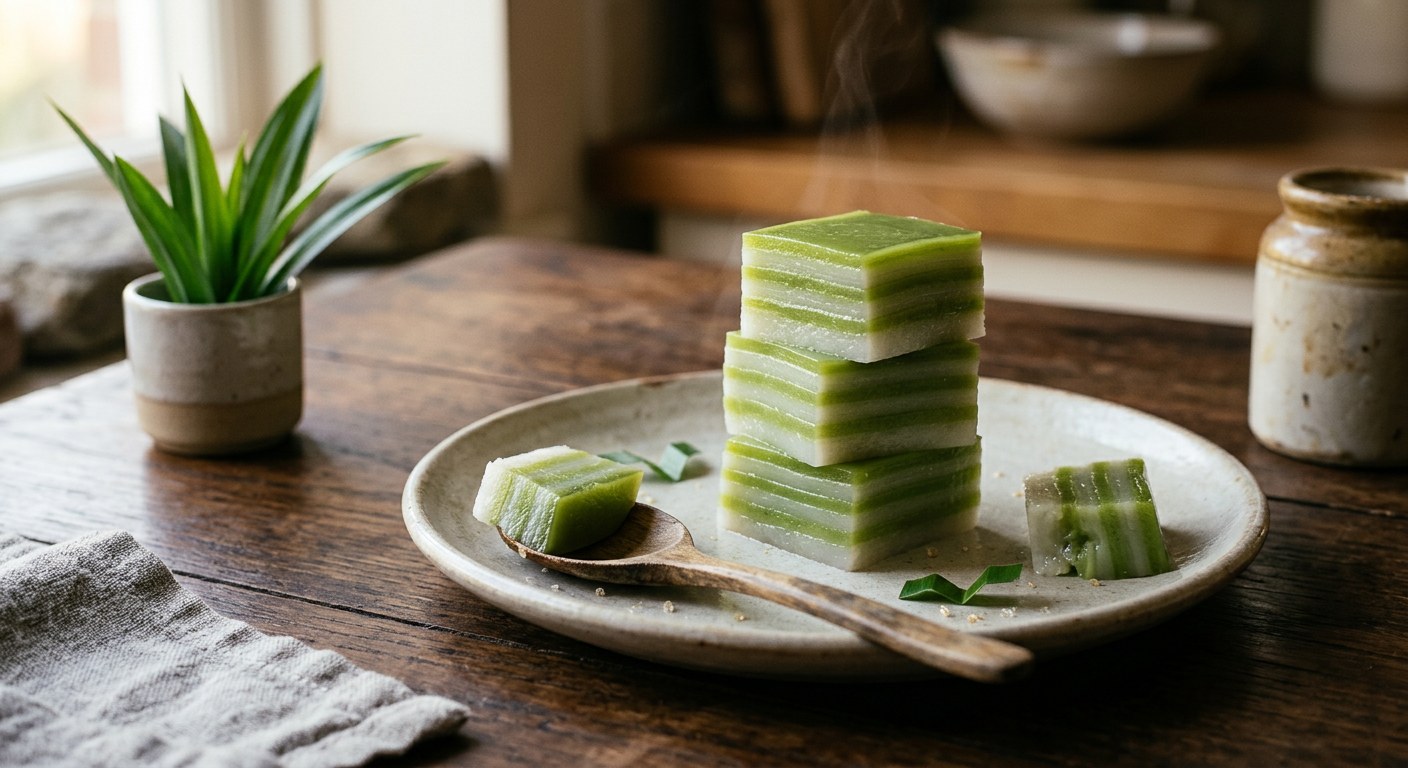
White and pandan-green batter steamed one thin layer at a time until the cake peels apart like pages — soft, chewy, fragrant, and built nine layers tall for luck.
ขนมชั้น — "layered sweet" — is built the slow way: batter poured a few millimetres deep, steamed until it sets, then the next layer poured on top, over and over until the tray is full. That is the whole point of the cake: each layer stays separate, and the finished block peels apart in thin, translucent sheets that pull cleanly off the layer below — Pim's ครัวบ้านพิม tested her formula through half a dozen batches to get exactly that behaviour.
The texture comes from the flour trio. Kapook's recipe mixes rice flour, tapioca starch and arrowroot flour and kneads the blend into sweetened coconut milk by hand for fifteen minutes — the kneading is what gives the cake its spring. Pim kneads thirty to forty minutes and is blunt about the rule: the longer you knead, the softer the cake. Aroifin's selling batch is gentler, five minutes, because its batter is looser.
Layers count. Aroifin records the auspicious rule: drop nine layers for the lucky number nine — the number for housewarmings and promotions. Kapook builds nine to ten, alternating white and green; Wongnai's three-tone version grades its pandan from white through light to dark green. The colour itself is negotiable — Pim admits her shortcut is plain green food colouring — but the layer discipline is not.
| Thai | English | Amount |
|---|---|---|
| น้ำตาลทราย | Sugar | 2½ cups |
| น้ำกะทิ | Coconut milk | 4 cups |
| แป้งข้าวเจ้า | Rice flour | ½ cup |
| แป้งมันสำปะหลัง | Tapioca starch | ½ cup |
| แป้งเท้ายายม่อม | Arrowroot flour | 1½ cups |
| น้ำใบเตยคั้นเข้มข้น | Concentrated pandan juice | ½ cup |
| น้ำหอมกลิ่นมะลิผสมน้ำ | Jasmine-scented water | ½ cup |
The selling ratio (TrueID, per tray): 25 g rice flour, 145 g tapioca starch, 55 g arrowroot flour, 280 g sugar, ¼ tsp salt, 650–750 g coconut cream and thin coconut milk, 50 g concentrated pandan juice (15 leaves blended with 1 cup of water, strained to ½ cup). The condensed-milk build (Wongnai): 276 g tapioca starch, 62 g rice flour, 30 g arrowroot, 30 g mung bean flour, 1,200 ml coconut milk, 100 g sweetened condensed milk, 200 g sugar, 300 ml pandan juice.
The flour blend. Kapook: ½ rice : ½ tapioca : 1½ arrowroot. Aroifin: 200 g tapioca : 25 g rice : 25 g arrowroot — arrowroot barely present. Pim: tapioca-led with cornstarch and a small arrowroot fraction. Wongnai adds mung bean flour and condensed milk. Every blend steams into the same chewy sheet; the ratio shifts the chew toward bounce (tapioca) or snap (rice).
The kneading time. Five minutes (Aroifin's loose selling batter), fifteen (Kapook), thirty to forty (Pim — "the longer you knead, the softer the cake"). The kneading develops the starch structure; the difference is mouthfeel, not correctness.
The colour. Real pandan juice (Kapook, TrueID, Wongnai), a three-tone pandan gradient (Wongnai's UGC), or plain green food colouring admitted openly (Pim's shortcut). Some add jasmine-scented water to the white layer for fragrance; others keep the white layer plain coconut.
The layers. Nine for luck (Aroifin's housewarming rule), nine to ten (Kapook), eight or nine (Pim). Nobody builds fewer than eight — the layer count is the dish's identity.
The steaming time. A flat 5 minutes per layer (Kapook, Aroifin), 3–5 minutes depending on thickness (Wongnai), or Pim's escalating clock: 5 minutes for layer one, then 6, 7, 8, 9, 10, 11 and 13 minutes for the last — each new layer must cook through the ones beneath it.
The knife. Hot water on the blade (Kapook) versus oil on the blade (Wongnai). Both exist to stop the sticky cake gripping the steel.
This recipe is translated from the following Thai-language sources. Where they disagree, we've said so.
1. Kapook Cooking — Rin Silpachai, "วิธีทำขนมชั้นใบเตย ขนมไทยสีสันสดใส เนื้อเหนียวนุ่ม" (the recipe used here) — cooking.kapook.com
2. ครัวบ้านพิม — "ขนมชั้น...ร๊าาากกก เธอ" (the tested formula and escalating steam times) — pim.in.th
3. Aroifin — "วิธีทำ ขนมชั้น ขนมไทยสีสวย เนื้อนุ่มเหนียว ทำง่าย หอมกะทิ" (the nine-layer rule and batch nutrition) — aroifin.com
4. TrueID Food — "10 สูตรทำ ขนมชั้น ขนมไทย สูตรทำขาย หลากสไตล์" (the selling ratio) — food.trueid.net
5. Wongnai — "วิธีทำ 'ขนมชั้น' เหนียวนุ่มหอมใบเตย หวานมันทำง่าย มือใหม่ก็ทำได้!" (the condensed-milk build) — wongnai.com
6. Wongnai — หลุมดำผู้ดูดกลืน, "วิธีทำ 'ขนมชั้น' เมนูขนมไทยยอดฮิต หอมใบเตย เหนียวนุ่มหยุดกินไม่ได้!" (the three-tone gradient) — wongnai.com