Recipe · Thailand · The Market Stall Classic

Khanom Buang (ขนมเบื้อง)

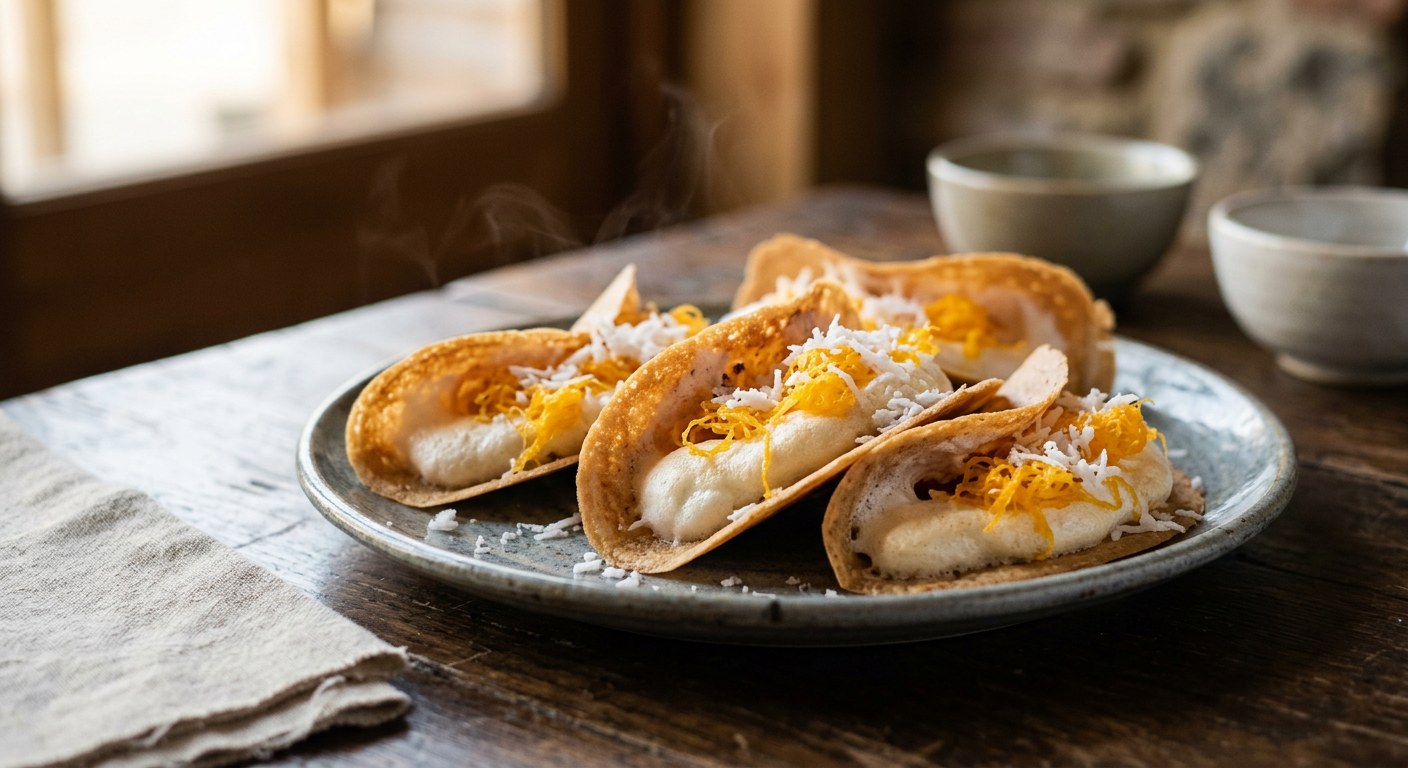
Wafer-thin rice-flour shells, a meringue that cooks and puffs the moment it touches the pan, golden egg threads and coconut — folded in half while they still crackle.

Khanom Buang — Wafer-thin rice-flour shells smeared on a hot pan, filled with a whipped egg-white meringue that cooks and puffs

The Street Sweet Thailand Folds in Half

ขนมเบื้อง is the two-part trick of Thailand's market stalls: a batter smeared so thin the shell shatters, and a sweet meringue that bakes and puffs the second it lands on the hot pan. Aroifin describes it as a dessert handed down from the grandparents' generation — one that many vendors have turned into a full-time trade — and TrueID notes that wherever you find a Thai market, a khanom buang stall is never far away. The classic topping is ฝอยทอง, the golden egg-yolk threads of Thai sweets, scattered over grated coconut.

The modern home version — the one Aroifin and Kapook (via Pantip member Diary Delicious) publish — builds the batter from rice flour and mung bean flour loosened with ice-cold water, a whole egg and palm sugar. But the older recipes insist on the crispness aids the quick version drops: Wongnai's ครูโย roasts and grinds whole mung beans at home, then kneads the flour with lime water, salt and a duck egg yolk; Pannipa's uses rice flour alone, sweetened with coconut sugar, and also works in น้ำปูนใส, the clear slaked-lime water that keeps the shell brittle.

The fillings then split the stall in two. The sweet half — foi thong and grated coconut — is universal. The savoury half has its own schools: Pannipa fries grated mature coconut in shrimp fat with salt and kaffir lime leaves until dry and loose, while ครูโย stir-fries chopped shrimp with garlic, pepper and grated coconut, and both finish with spring onion and sesame. Fold, rest on the rack, and eat warm.

The Recipe (home version, from Aroifin — the same batter Kapook's Pantip member uses)

ThaiEnglishAmount
แป้งข้าวเจ้าRice flour100 g
แป้งถั่วเขียว (หรือแป้งซาหริ่ม)Mung bean flour50 g
น้ำเย็นจัดIce-cold water150 g
ไข่ไก่Egg1
น้ำตาลปี๊บPalm sugar100 g
ไข่ขาวEgg whites¾ cup (about 2 eggs)
น้ำตาลไอซิ่ง หรือน้ำตาลทรายละเอียดIcing sugar1 cup
น้ำมะนาวLime juiceA few drops
ฝอยทองFoi thong (golden egg-yolk threads)As needed
มะพร้าวขูดGrated coconutAs needed

The old-style batch (Wongnai, ครูโย): roast 300 g skinless mung beans, cool, grind fine and measure 2 cups; knead with 1 duck egg yolk, 2 tbsp lime water, 1 tbsp palm sugar, ¼ tsp salt and 1 tbsp plain flour; rest 20 minutes. Pannipa's โบราณ bowl: 200 g rice flour only, 200 g coconut sugar, 2–3 tbsp lime water, 150 ml water and 3 eggs — the yolks go into the batter, two of the whites into the cream. Her savoury filling fries 100 g finely grated mature coconut in 2 tbsp oil with shrimp fat and salt, plus 1–2 very finely sliced kaffir lime leaves, until dry and loose (see the disagreement below).

The Method

  1. The batter. Mix the rice and mung bean flours, pour in the ice-cold water and whisk, then the egg and palm sugar — whisk or rub by hand until the sugar fully dissolves. Rest 15–30 minutes; it's Aroifin's rest that lets the shell set thin and crisp instead of tough.
  2. The cream. Whip the egg whites with the icing sugar — fine sugar only, so it dissolves fast — and a few drops of lime juice, which brings the peaks up sooner. Stop at soft-to-firm peaks: firm enough to hold its shape, soft enough to stay tender when it bakes.
  3. The pan. Medium-low heat, wiped with an oiled cloth — Pannipa's method, not pooled oil. Ladle the batter and smear it as thin as physically possible; the shell should be thinner than a crepe.
  4. The fill. The moment the shell browns, smear on the cream — you'll see it cook and puff — then scatter the foi thong and grated coconut. Pannipa's warning stands: work fast, or the shell burns and turns bitter.
  5. The fold. Fold in half with a spatula and lift onto a wire rack, not stacked while hot, so the steam escapes and the shell stays crisp. Eat warm.

Where Thai Sources Disagree

The flour. Aroifin and Kapook use shop-bought rice flour plus mung bean flour. ครูโย roasts and grinds whole mung beans at home (300 g to 2 cups) and adds a spoon of plain flour for the knead. Pannipa drops the beans entirely — rice flour alone, with eggs for structure.

The lime water. ครูโย and Pannipa both knead น้ำปูนใส — clear slaked-lime water — into the batter for crispness that lasts. The modern home version drops it completely. If your khanom buang softens within the hour, that's the missing ingredient.

The batter sweetener. Palm sugar in Aroifin, Kapook and ครูโย; coconut sugar in Pannipa. Both must dissolve fully — a stray lump of either burns on the pan.

The cream. Icing-sugar meringue (Aroifin, Kapook) or granulated sugar poured in gradually (Pannipa). ครูโย offers two alternatives: hot syrup whipped into the whites, which cooks the egg — for anyone wary of raw egg white — or the truly old-school route with no meringue at all: the egg white kneaded with palm sugar until thick, smeared straight onto the shell.

Sweet, savoury, or both. Aroifin and Kapook publish the sweet-only crepe: foi thong and grated coconut. ครูโย and Pannipa make both, and disagree on the savoury filling — chopped shrimp stir-fried with garlic, pepper and grated coconut (ครูโย) versus grated coconut fried in shrimp fat with salt and kaffir lime leaves (Pannipa). Both top it with spring onion and sesame.
How Western Versions Get It Wrong

UK Ingredient Notes

Sources

This recipe is translated from the following Thai-language sources. Where they disagree, we've said so.

1. Aroifin — "วิธีทำ ขนมเบื้อง แป้งกรอบ ๆ ไส้หวานหอม อร่อยฟินทุกคำ!" (the recipe used here) — aroifin.com

2. Kapook — "ขนมเบื้องกรอบ ไส้ตูม ทำง่าย ๆ ใช้แค่กระทะเทฟลอน" by Diary Delicious, Pantip member (the same home batter, made on a non-stick pan) — cooking.kapook.com

3. Wongnai — "ขนมเบื้องโบราณ ไส้ครีม" by ครูโย โยโฮมคาเฟ่ (the old-style roasted mung bean batter and hot-syrup cream) — wongnai.com

4. Wongnai — "ขนมเบื้องโบราณ" by Pannipa Makvilai (the rice-flour batter and the savoury coconut–kaffir lime filling) — wongnai.com

5. TrueID Food — "ขนมเบื้องแบบ D.I.Y. ใครๆก็ทำได้ง่ายมากๆ" (background: the dessert's long history and its fixed place at Thai markets) — food.trueid.net

Johnny Tiger
Johnny researches and translates Thai recipes from Thai-language sources — chefs, restaurants and home cooks in Thailand — and publishes them with their sources cited. No westernised shortcuts, no invented steps.