Recipe · Thailand · The Palm-Fruit Cake That Ferments Itself

Kanom Tan (ขนมตาล)

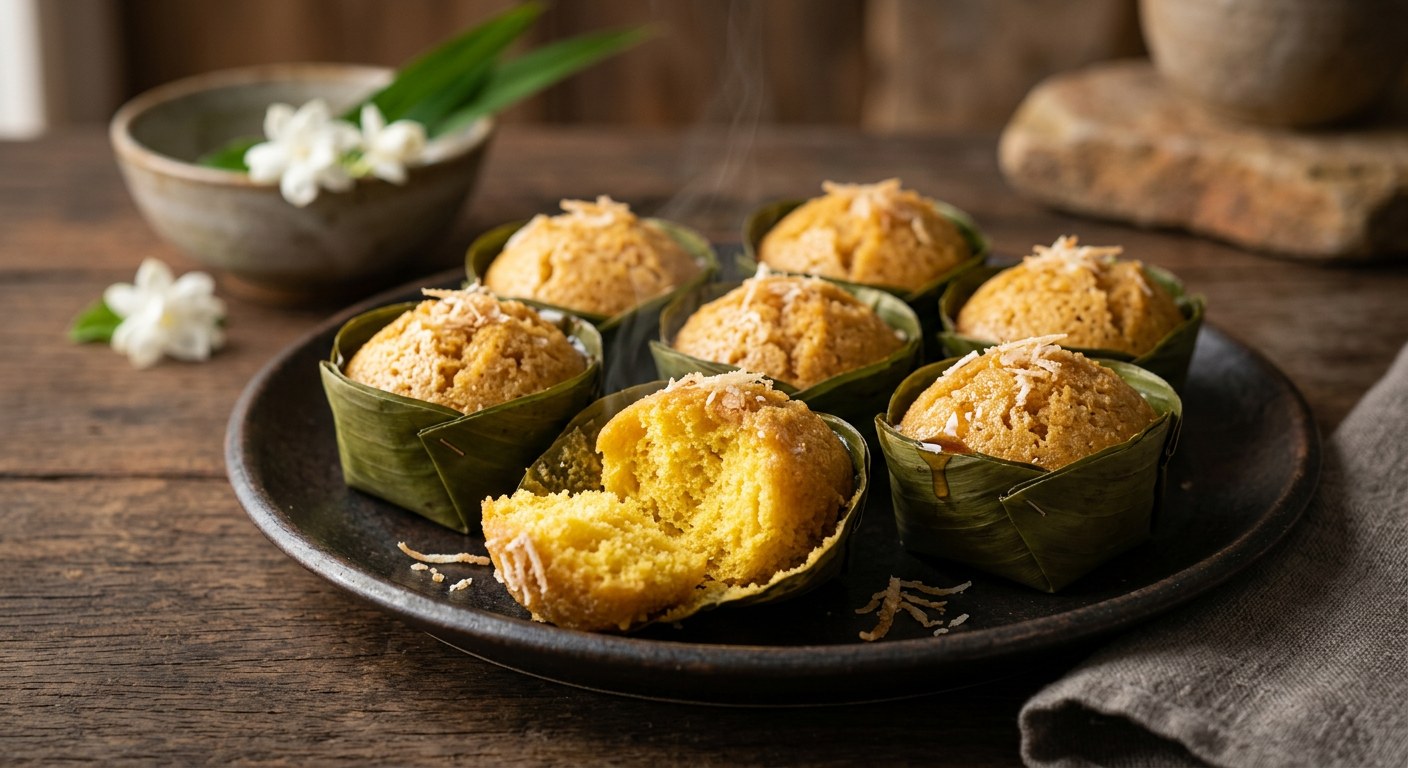
Ripe toddy palm fruit mashed and sieved into rice-flour batter with coconut milk, left to rise — by baking powder, dry yeast, or the fruit's own fermenting yeasts — then steamed in little cups under a crown of grated coconut.

Kanom tan (ขนมตาล) — steamed palm-fruit cakes in little banana-leaf cups, golden and topped with grated coconut

The Cake That Ferments Itself

ขนมตาล splits into its parts: ขนม (a sweet) and ตาล — the toddy palm, a word Thai borrowed from Pali and Sanskrit tāla, the tree Thais once called โตนด. Ripe fruit from the female palm, mashed and sieved, goes into rice-flour batter with coconut milk; the batter is steamed in little cups and finished with grated coconut. No eggs, no wheat — Thai Wikipedia counts it among the few genuinely native Thai sweets, untouched by the western influence that reshaped most of the dessert table.

It is a Sukhothai-era sweet, and its home is Phetchaburi — the dessert town, ขนมเมืองเพชร — where the traditional version (ขนมตาลโบราณ, locally ปุ or ตะโหนดเต้า) is still wrapped in palm leaf. Its signature is the smell: faintly boozy, like fermenting wine. The original recipe used no raising agent at all. The fruit's own yeasts did the work, fermenting while the mashed flesh dripped in a cloth bag hung from the rafters — the step Phetchaburi cooks call เกรอะตาล.

Modern recipes shortcut that step. Wongnai and Kapook reach for baking powder and a ten-minute rest. Aroifin kneads in dry yeast and waits four hours. A Cookpad grandmother forbids the powder outright — mix and wait, she says, it rises by itself. Wikipedia notes why the original matters: market versions that skimp on the fruit and fake the yellow with dye come out hard and scentless — the exact failure the old way was built to avoid.

The Recipe (baking-powder home version, from Kapook — makes about 10)

ThaiEnglishAmount
เนื้อลูกตาลสุกRipe palm fruit flesh, mashed400 g
แป้งข้าวเจ้าRice flour500 g
กะทิCoconut milk3 cups
น้ำตาลทรายWhite sugar400 g
ผงฟูBaking powder1 tbsp
มะพร้าวขูดเส้นเล็กFinely grated coconut2 cups
เกลือSalt (to toss with the coconut)a little

The yeast route (Aroifin): same fruit, but 250 g rice flour plus 200 g tapioca starch, 1 kg coconut cream and thin coconut milk, 2 tsp dry yeast, baking powder dissolved in the thin milk only at the end, and a 4–5 hour rest. The traditional route (Krua): no raising agent — the mashed fruit is sieved, hung to drip about 8 hours (เกรอะตาล) while its natural yeast ferments it, and the flour is kneaded with coconut cream for a full 30–60 minutes. Wongnai's half batch: 200 g fruit, 250 g rice flour, 320 ml coconut milk, 200 g sugar — 5 servings, 300 kcal each.

The Method

  1. The fruit. If you have fresh ripe palm fruit: peel it, mash the yellow flesh with a little water and a pinch of salt — the salt cuts the raw, astringent edge, per Krua's Phetchaburi cooks — scrape it through a sieve to shed the fibres, then squeeze it in cheesecloth and hang it to drip, up to 8 hours or overnight. From a tin: drain and mash; the work is done.
  2. The batter. Dissolve the sugar in the coconut milk, then stir in the fruit. Add the rice flour and baking powder and stir smooth, then pass through a sieve. Rest 10 minutes — just long enough for the batter to set.
  3. The long rest — the yeast way. For the fermented version, skip the powder: knead the flour with the coconut milk well (Krua insists the kneading is what makes the cake tender — at least 30 minutes), add the fruit and sugar, cover, and leave 3–4 hours until the batter foams on its own. Cookpad's grandmother is right: no powder, just patience.
  4. The cups. Arrange your little cups in the steamer — banana-leaf cups (กระทงใบตอง) or the Thai clay cups called ถ้วยตะไล — and steam them empty for one minute first. Aroifin and Wongnai both use this trick so the cakes will not stick.
  5. The coconut. Fill each cup to the top. Kapook and Cookpad sprinkle the salted grated coconut on before steaming so it bakes in; Aroifin and Wongnai scatter it on the finished cakes. Either way, the coconut is not optional.
  6. The steam. Steam over boiling water on high heat for 15–20 minutes, then cool and unmould. Serve warm or at room temperature — the cake should be springy, not wet.

Where Thai Sources Disagree

The rise. Baking powder only, ten minutes' rest (Kapook, Wongnai). Dry yeast plus baking powder, four hours' rest (Aroifin). Nothing at all but time — the fruit's own yeast (Cookpad's grandmother; Krua's traditional เกรอะตาล). The original, per Wikipedia, is the last one: the traditional Phetchaburi cake carries the fermented-wine aroma, and no powder can fake it.

When the coconut goes on. Before steaming, salted and sprinkled on the raw batter (Kapook, Cookpad) — or after steaming, on the cooled cakes (Aroifin, Wongnai). Steamed-in coconut melds into the top; added-after coconut stays snow-white and separate.

The flour. Rice flour alone (Kapook, Wongnai, Cookpad) or rice flour cut with tapioca starch (Aroifin, 250 g to 200 g). Krua settles it from the other direction: the tenderness comes from kneading the flour with coconut cream for 30–60 minutes, not from the flour itself.

Knead or whisk. Aroifin and Krua knead — Aroifin in a mixer for half an hour, Krua by hand for up to an hour, and both warn that under-kneaded batter bakes up hard and crumbly. The quick versions whisk, sieve, and go.

The wrapper. Banana-leaf cups (Aroifin, Wongnai), the ceramic ถ้วยตะไล (Kapook, Cookpad), palm leaf for the traditional Phetchaburi version (Wikipedia), and Krua's historical list — ใบขี้เหม็น, ใบตาล, ใบตอง, ใบเขียง, ใบกร่าง — leaves that supposedly stink raw but smell sweet once steamed.

The salt. In the batter (Aroifin, Cookpad — 1 tsp / 6 g), in the coconut topping (Kapook), or in the fruit itself while mashing, to tame its bitterness (Krua). All three agree the dish needs a trace of salt somewhere.
How Western Versions Get It Wrong

UK Ingredient Notes

Sources

This recipe is translated from the following Thai-language sources. Where they disagree, we've said so.

1. Kapook Cooking — "ขนมตาล สูตรขนมไทยสีเหลืองนวลเนื้อเหนียวนุ่ม หอมอร่อย" (the recipe used here) — cooking.kapook.com

2. Wongnai — "วิธีทำ 'ขนมตาล' เมนูขนมไทย หอมนุ่มถูกปาก สีสันถูกใจ" (the half batch, 300 kcal per serving) — wongnai.com

3. Aroifin — "วิธีทำ ขนมตาล ขนมไทย รสชาติอร่อย สีสวยน่าทาน ทำขายกำไรดี" (the yeast-plus-powder route, kneading and 4–5 hour rest) — aroifin.com

4. Krua.co — "ขนมตาลที่แท้ต้องนุ่มหยุ่นจากยีสต์ธรรมชาติ" by ณัฐณิชา ทวีมาก (the Phetchaburi tradition: เกรอะตาล, the leaf wrappers, the kneading) — krua.co

5. Cookpad (piya peipei) — "ขนมตาล 👵🏻 สูตรยายห้ามใช้ผงฟู" (grandmother's no-baking-powder method; fruit squeezed and hung, batter rested 4 hours) — cookpad.com

6. วิกิพีเดีย — "ขนมตาล" (history from Sukhothai, etymology, the traditional ปุ / ตะโหนดเต้า of Phetchaburi, nutrition) — th.wikipedia.org

Johnny Tiger
Johnny researches and translates Thai recipes from Thai-language sources — chefs, restaurants and home cooks in Thailand — and publishes them with their sources cited. No westernised shortcuts, no invented steps.