The north's curry of the fence-line: a laab-style paste with makwaen, chicken or pork, and the garden's many greens — no coconut, no fancy technique, just the vegetables of the house.
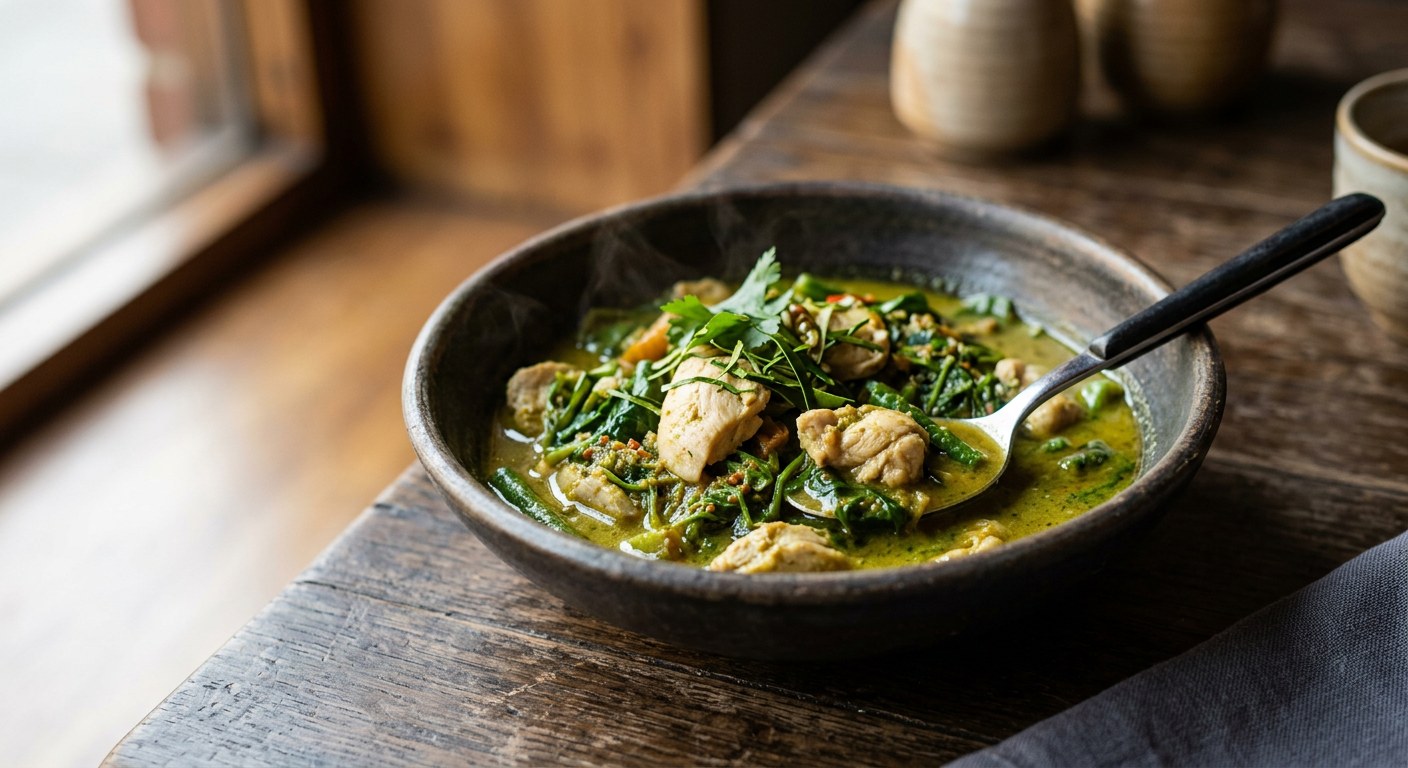
แกงแค is named not for a sauce but for its vegetables. TrueID's writers describe the classic: the wild greens gathered from around the house are called ผักครัวแค — the kaeng khae kitchen greens — cooked with a paste they describe as a northern laab paste with pla ra added, then built around chicken or pork. The curry then takes its meat's name: แกงแคไก่, chicken kaeng khae, and the pork and other versions that follow. It is the north's answer to "what shall we eat today" — whatever the garden answers.
The paste is where the region speaks. Mahidol's nutritionists pound dried chillies with makwaen and maklaep — the prickly-ash spices of the north — along with galangal, lemongrass, coriander roots and shrimp paste. TrueID's village version roasts the chillies first, uses yellow galangal and makwaen, and pounds chopped pla ra into the paste itself. The pot build then splits three ways: Mahidol fries chopped garlic golden, fries the paste, seals the chicken in it and simmers everything in pork bone stock; Wongnai's home cook simply fries a ready-made paste sachet with chicken and water.
And there is a third, wilder build. TrueID's rainy-season recipe replaces the usual greens with บุกลาย, the toxic arum stem, boiled in the paste broth until completely soft — the heat destroys the toxin, the author insists, and it must never be eaten undercooked — then finished with cha-om and cha phlu and served with hot sticky rice. Mahidol adds the health case for the everyday version: the greens make the curry high in fibre and, their analysis notes, notably high in antioxidants.
| Thai | English | Amount |
|---|---|---|
| พริกแห้ง (เม็ดใหญ่) | Dried chillies (large) | 8 |
| หอมแดง | Shallots | 6 heads |
| กระเทียมไทย | Garlic | 15 cloves |
| ข่า | Galangal | 5 slices |
| ตะไคร้ (ซอย) | Lemongrass, chopped | ⅓ cup |
| รากผักชี | Coriander roots | 3 |
| มะแกว่น | Makwaen | 1 tbsp |
| มะแหล่บ | Maklaep | 1 g |
| เกลือ | Salt | ½ tsp |
| กะปิ | Shrimp paste | 2 tsp |
| เนื้อไก่ | Chicken meat | 175 g |
| เห็ดลมแห้ง | Dried hed lom mushrooms | 33 |
| ใบสะเรดพังพอน (เมีย) | Saed phangphon leaves | ½ cup |
| ผักเผ็ด | Phak phet shoots | ½ cup |
| ใบพริก | Chilli leaves | ½ cup |
| ผักชีฝรั่ง | Culantro | ¼ cup |
| ใบชะพลู | Cha phlu leaves | ½ cup |
| ชะอม | Cha-om | ½ cup |
| ถั่วแปบ | Hyacinth beans | ⅓ cup |
| มะเขือเปราะ | Thai round aubergine | 1 cup |
| พริกไทยอ่อน | Green peppercorns | ¼ cup |
| มะเขือพวง | Pea aubergines | 1 ladle |
| มะระขี้นก | Small bitter gourd | ½ ladle |
| ถั่วฝักยาว | Long beans | 1 ladle |
| ข่าอ่อน | Young galangal | 6 slices |
| น้ำมันพืช | Vegetable oil | 3 tsp |
| กระเทียม (สับ) | Garlic, chopped | 15 cloves |
| น้ำซุปกระดูกหมู | Pork bone stock | 1 large bowl |
The ready-paste home version (Wongnai): for 3–4 — 3 diced chicken thighs, a bunch of ivy gourd leaves, 5 long beans, 3 round aubergines, 6–7 oyster mushrooms, a pinch of kapok flower, 2 culantro stalks, 2 long chillies, one sachet of kaeng khae paste, shrimp paste, fish sauce and sugar; the paste is fried with the chicken, water added, vegetables in, ivy gourd leaves last. The village version (TrueID): a whole village chicken blanched and scorched, cut up and fried with a paste of 15 roasted dried chillies, yellow galangal, lemongrass, garlic, makwaen and a spoon of chopped pla ra, then boiled and finished with garden greens and a last-minute handful of toasted rice to thicken. The rainy-season bowl (TrueID): buk lai arum stems boiled in the pla ra paste broth until fully soft, then cha-om and cha phlu — gloves for the peeling, sticky rice on the side.
Pla ra or not. TrueID's two recipes put pla ra into the paste itself — a tablespoon chopped in the chicken version, a whole ladle in the buk lai version. Mahidol's academic paste uses shrimp paste instead, and Wongnai's home cook has no fermented fish anywhere. Both builds are authentic; the north splits on this by household.
The liquid. Mahidol alone simmers in pork bone stock; Wongnai and TrueID use water. The stock build is richer and faintly cloudy; the water build is leaner and lets the greens speak louder.
The thickener. TrueID's village recipe finishes with toasted rice — khao khua — stirred in last until the broth thickens. Mahidol and Wongnai thicken nothing; the broth stays clear.
The greens list. No two sources agree, and that is the point. Kapok flower and ivy gourd leaves appear only in Wongnai; hed lom mushrooms, hyacinth beans, small bitter gourd, chilli leaves and young galangal only in Mahidol; sawtooth coriander and hom yae only in TrueID's garden list. ผักครัวแค is whatever the fence grows — the recipe is a template, not a shopping list.
The paste spices. Mahidol pairs makwaen with maklaep; TrueID pairs makwaen with yellow galangal, and roasts the chillies before pounding. Wongnai buys the paste in a sachet.
The chicken. TrueID's village version blanches and scorches a whole free-range bird; Wongnai dices three thighs; Mahidol weighs out 175 g of meat. The texture differs — village chicken wants a longer boil until tender.
This recipe is translated from the following Thai-language sources. Where they disagree, we've said so.
1. Mahidol University Institute of Nutrition — "แกงแค (ตำรับนี้รับประทานได้ประมาณ 6 คน)" (the recipe used here) — inmu.mahidol.ac.th
2. Wongnai — "สูตร แกงแคไก่ พร้อมวิธีทำโดย ชิมทั่วไทยว่างเมื่อไหร่เข้าครัว" (the ready-paste home version) — wongnai.com
3. TrueID Food — "แกงแคไก่ รสเด็ดถูกใจ สไตล์อาหารเหนือ" (the village-chicken and toasted-rice version) — food.trueid.net
4. TrueID Food — "สูตรเด็ดอาหารเหนือ แกงแคต้นบุกลาย" (the rainy-season buk lai variant) — food.trueid.net