Recipe · Thailand · Noodles · The Bowl Every Stall Sells

Bamee Kiao (บะหมี่เกี๊ยว)

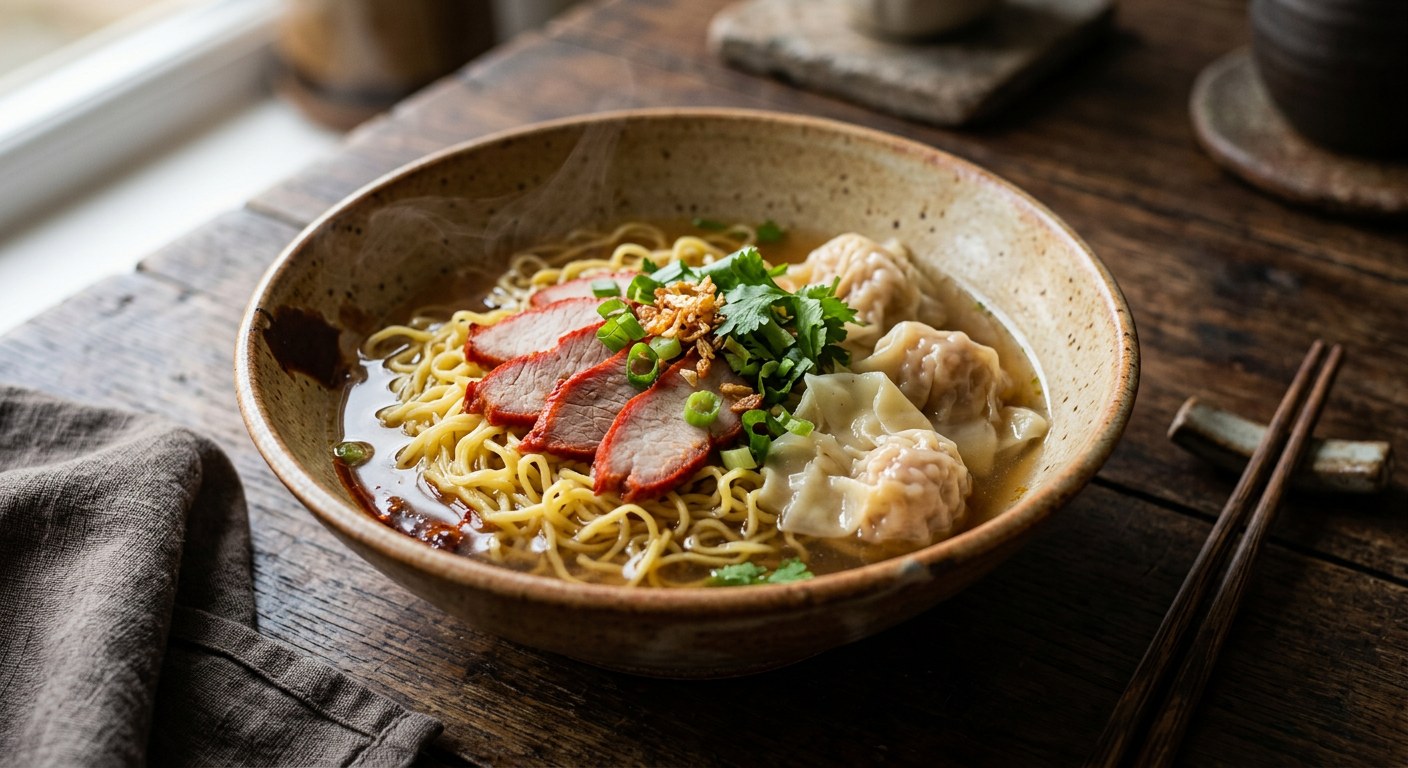
Egg noodles and hand-folded wontons in a clear pork-bone broth, crowned with red barbecue pork — the noodle bowl that anchors every Thai street-side stall, from breakfast to last orders.

Bamee Kiao (บะหมี่เกี๊ยว) — Egg Noodles with Wontons and Barbecue

A Bowl With Three Crafts In It

บะหมี่เกี๊ยว is a dish assembled, not just cooked: there is the บะหมี่ — fresh yellow egg noodles; the เกี๊ยว — wontons, folded by hand around a pork filling; and the หมูแดง — char siu, the red barbecue pork that gives the bowl its sweetness and its colour. The fourth element, the broth, is the quiet one: pork bones simmered with coriander root, garlic and peppercorns, the same aromatic trinity (สามเกลอ) that seasons the filling.

Thai sources treat it as a Chinese-Thai dish — KRUA.CO's dry version is explicitly built on Cantonese wonton wrappers and Cantonese egg noodles — but the bowl as sold in Thailand is its own thing: generous, sweet-edged, and finished with fried garlic rather than the Cantonese scallion oil. The Wongnai cook ปีศาจหมู notes it can be served three ways from one pot: as soup, dry (haeng), or tom yum.

The stall version is also a family version. Every source here makes it at home, and the honest message in all of them is that the parts are simple; what takes time is the broth and the char siu. Do those well and the assembly is ten minutes.

The Recipe (home version, from Kapook / Wongnai)

ThaiEnglishAmount
บะหมี่ไข่Fresh egg noodles400 g
แผ่นเกี๊ยวWonton wrappers1 pack
หมูสับMinced pork200 g
กุ้งสับMinced prawns100 g
รากผักชีCoriander roots2
กระเทียมGarlic1 tbsp
พริกไทยเม็ดWhite peppercorns1 tsp
ซีอิ๊วขาวLight soy sauce1 tbsp
แป้งข้าวโพดCornflour1 tsp
ผักกวางตุ้งChoy sum, cut short100 g
หมูแดงChar siu (red barbecue pork), sliced1 piece
น้ำซุปหมูPork broth (bones, coriander root, garlic, peppercorns)1.5 litres
กระเทียมเจียวFried garlic, spring onion, ground white pepperto finish

The dry bowl (KRUA.CO): 6 Cantonese wonton wrappers, 2×45 g Cantonese egg noodle cakes, 40 g choy sum, 70 g sliced char siu, half a cup of char siu sauce, garlic oil for tossing, and fried garlic, crispy pork fat and spring onion on top — served with the pork-bone broth on the side and the full condiment tray (pickled chilli vinegar, fish sauce, sugar, chilli powder). The big-family pot (Pim): 1 kg pork neck for the char siu, 250 g fatty minced pork for 45–50 wontons, and a 7-litre broth from pork knuckle bones with white radish, pickled garlic and rock sugar. The three-way pot (Wongnai UGC): pork, prawn or crab fillings, folded golden-cup style, served as soup, dry, or tom yum with chilli jam and crushed peanuts.

The Method

  1. The filling. Pound the coriander roots, garlic and white peppercorns together — this is the สามเกลอ trinity — then work the paste into the minced pork and prawns with the soy sauce and cornflour. Knead until the meat turns sticky and holds together; Pim adds iced water at this point to keep the filling springy, and Kapook's version folds in minced prawn for sweetness.
  2. The fold. A teaspoon of filling in the centre of each wrapper. The easy fold is a triangle, pressed shut at the edges; the stall fold is the ถ้วยทอง (golden cup) — pull the two corners up and pinch them together over the filling. Keep finished wontons under a damp cloth so the skins do not dry, and cook them the same day.
  3. The broth. Pork bones in cold water, bring to the boil, skim the scum — the Wongnai UGC cook warns not to stir once the bones are in, or the broth clouds. Add coriander roots, garlic and peppercorns, drop to a gentle simmer and leave it an hour or two. Season lightly: salt and a touch of sugar or light soy, and never so much that the broth loses its clear colour.
  4. The char siu. Marinate the pork — Kapook's classic marinade is cinnamon, star anise, garlic, honey, tomato sauce, oyster sauce, light soy and orange colouring, a good three to four hours — then simmer it in the marinade until cooked and finish in a hot oven for ten to fifteen minutes until the surface dries and glazes. Wongnai's quick route boils the marinated pork, then roasts ten minutes at 200°C. Slice thinly on the diagonal.
  5. The blanch. A big pot of boiling water, and an order to it: choy sum first (seconds only), then the noodles, unravelled with chopsticks so they cook evenly, then the wontons — they are done when they float. Toss the noodles in a little garlic oil as soon as they drain so they never clump.
  6. The bowl. Noodles and choy sum in the bowl, wontons and sliced char siu arranged on top, hot broth ladled over, then fried garlic, spring onion and ground white pepper. Put the condiment tray on the table: pickled chilli vinegar, fish sauce, sugar and chilli powder — that is where each eater finishes the bowl to taste.

Where Thai Sources Disagree

The wonton filling. Wongnai's Arunaa, Pim and KRUA.CO use pork alone — Pim's is fatty minced pork with sesame oil and iced water, KRUA.CO's adds pork belly, pork fat and spring onion, Cantonese style. Kapook goes pork and prawn (200 g pork to 100 g prawn), and the Wongnai UGC cook offers pork, whole prawn or crab. Everyone keeps the same seasoning base: coriander root, garlic, white pepper, light soy.

The char siu. Three roads to the same red pork. Kapook: the full classic — cinnamon, star anise, honey, tomato sauce, marinated three to four hours, simmered, then oven-finished. Wongnai's Arunaa: a quick home version — salt, pepper, sugar, oyster sauce, chilli sauce and red colouring, marinated one to two hours, boiled, then ten minutes at 200°C. Pim: a ready-made char siu marinade thinned with evaporated milk, marinated 24–48 hours. The Wongnai UGC cook skips char siu entirely and serves the bowl without it.

The broth. Bones, coriander root, garlic and peppercorns is the common base. Pim scales it up to a stall-sized 7 litres and adds white radish and pickled garlic; KRUA.CO and Pim both add rock sugar (น้ำตาลกรวด) for the soft sweetness; the Wongnai UGC cook prefers it nearly bare — salt, a little sugar, and only a splash of soy, to keep the broth clear and pale.

Wet or dry. KRUA.CO is the only source that serves the bowl exclusively dry — noodles and wontons tossed in garlic oil with char siu and sauce on top, the broth alongside as a drink. The rest ladle the soup over the noodles. The Wongnai UGC cook simply makes one pot and serves it all three ways: soup, dry, or tom yum with chilli jam, crushed peanuts, chilli powder, lime, sugar and fish sauce.
How Western Versions Get It Wrong

UK Ingredient Notes

Sources

This recipe is translated from the following Thai-language sources. Where they disagree, we've said so.

1. Wongnai — "แจกสูตรฟรี บะหมี่เกี๊ยวหมูแดง" by อรุณา (the quick home char siu and the bowl used here) — wongnai.com

2. ครัวบ้านพิม (Pim) — "บะหมี่เกี๊ยวหมูแดง" (the stall-scale broth with white radish and pickled garlic; the wonton filling with iced water) — pim.in.th

3. KRUA.CO — "บะหมี่เกี๊ยวแห้งหมูแดง" (the dry Cantonese-style bowl, garlic oil and the condiment tray) — krua.co

4. Kapook Cooking — "บะหมี่เกี๊ยวหมูแดง เสิร์ฟร้อน ๆ อร่อยเต็มอิ่ม" (the classic five-spice char siu; the pork-and-prawn filling) — cooking.kapook.com

5. Wongnai — "สูตร บะหมี่เกี้ยว" by ปีศาจหมู (the golden-cup fold, the three-way serving, the clear-broth rule) — wongnai.com

Johnny Tiger
Johnny researches and translates Thai recipes from Thai-language sources — chefs, restaurants and home cooks in Thailand — and publishes them with their sources cited. No westernised shortcuts, no invented steps.